WooCommerce is free software that costs real money to run: hosting, themes, plugins, security and someone’s time keep a typical small store at roughly US$1,000 to US$1,500 a year before payment processing. Sendd charges 1% per sale with no subscription and manages all of the infrastructure for you. Choose WooCommerce if you want maximum control and have the technical capability to be your own platform team. Choose Sendd if you want to sell, not administer a WordPress stack.
Key takeaways
- The WooCommerce plugin is free. A production store is not: one study of 5,000 real WooCommerce stores puts a typical year at about US$982 to US$1,186 before processing.
- Sendd charges 1% per sale, no subscription, with hosting, security, updates and infrastructure managed for you.
- WooCommerce itself adds no transaction fees, an honest advantage over percentage models at high volume.
- WooCommerce gives you total control and the largest open source ecosystem in commerce. You also own every problem: hosting, security patching, plugin conflicts and updates.
- Sendd has native email marketing and segmentation (free credits cover 500 contacts, then half or less of Klaviyo’s price, unlimited sends) and Rocky, an AI assistant, without assembling plugins.
Contents: Is WooCommerce really free? · What each costs at different sales volumes · What you maintain on WooCommerce that Sendd handles · What Sendd includes that WooCommerce needs plugins for · When WooCommerce is the right choice · Migrating from WooCommerce to Sendd · FAQ
Is WooCommerce really free?
The software is free. The store is not. A working WooCommerce store needs hosting, a domain, a theme, plugins, security and maintenance, and analysis of real plugin usage across 5,000 WooCommerce stores puts a typical small-to-medium store at about US$982 a year, or US$1,186 with email marketing (Wombat Plugins, 2026 ). WooCommerce’s own pricing guidance frames realistic annual totals from about US$1,800 upward once quality hosting and paid extensions are included (Swell, 2026 ).
| Sendd | WooCommerce (typical small store) | |
|---|---|---|
| Software | $0 | $0 (open source plugin) |
| Subscription / platform fee | 1% per sale | 0% |
| Hosting | Included | ~US$30/month for WooCommerce-grade hosting |
| Theme | Included | Free basic, or US$59 to $99/year premium |
| Email marketing + segmentation | Native, free tier then half or less of Klaviyo’s price, unlimited sends | Plugin or external service, extra |
| Security, updates, maintenance | Managed by Sendd | Your responsibility |
| Payment processing | Your own Stripe, or flat 30¢ bank transfer in NZ | Stripe or gateway of choice, standard rates |
Figures checked 10 August 2026.
Be fair to WooCommerce on two points. It charges no percentage of your sales ever, which means at high volume it can be the cheapest serious platform on pure fees. And as open source WordPress software it offers control nothing hosted can match: your server, your database, your code, modified however you like, with an enormous ecosystem of plugins and developers behind it.
What does each cost at different sales volumes?
At US$2,000/month in sales, Sendd’s platform fee is about $20/month against a WooCommerce baseline of roughly $85 to $125/month in fixed running costs. At US$20,000/month, Sendd’s 1% is $200/month and WooCommerce’s fixed costs barely move.
| Monthly sales | Sendd platform fee | WooCommerce fixed costs (typical) |
|---|---|---|
| $500 | $5 | ~$85 to $125 |
| $2,000 | $20 | ~$85 to $125 |
| $5,000 | $50 | ~$85 to $125 |
| $10,000 | $100 | ~$100 to $150 |
| $20,000 | $200 | ~$100 to $200 |
Excludes payment processing, which applies similarly on both. WooCommerce range reflects hosting tiers and plugin stacks scaling with traffic. Figures checked 10 August 2026.
The crossover on pure fees sits around US$10,000 to $15,000 a month. But this table hides the real WooCommerce cost, which is not money. It is that every line item comes with a job: choosing hosting, patching WordPress, resolving plugin conflicts, restoring backups and diagnosing why checkout broke on a Saturday. If you enjoy that work or employ someone who does, WooCommerce rewards you. If you do not, the “free” platform costs you your scarcest resource.
Try your own numbers in the Sendd fee calculator .
What do you have to maintain on WooCommerce that Sendd handles?
On WooCommerce you are the platform team: hosting performance, WordPress core updates, plugin updates and compatibility, security hardening, backups and PCI-relevant configuration are all yours. On Sendd all of that is managed, and your job is the store.
WordPress powers a huge share of the web, which makes it a constant attack target, and a compromised store means cleanup costs, downtime and lost trust (Rovela, 2026 ). None of that is an argument that WooCommerce is bad software. It is an argument that WooCommerce is a responsibility, and the honest question is whether you want it.
There is also a stacking effect on functionality. Subscriptions, bookings, advanced shipping and email automation are each plugins on WooCommerce, each with a licence, an update cycle and a potential conflict. On Sendd, physical products, digital products, subscriptions, event tickets, services and rentals are native formats in one store, with the 1% fee applying to every format. The full breakdown of what each part costs is in How Sendd Pricing Works in 2026 .
What does Sendd include that WooCommerce needs plugins for?
Sendd has native email marketing, customer segmentation and Rocky, an AI assistant that works over your commerce and customer data, with no plugin assembly. Free monthly credits cover your first 500 contacts; beyond that, pricing runs at half or less of Klaviyo’s with unlimited sends.
Ask Rocky in plain language to find everyone who viewed a product, bought something in the last six months and attended your launch event, then email them an offer, and it builds and actions that segment. Reproducing that on WooCommerce means an email platform subscription, an events plugin, an analytics layer and integration work between them. Sendd MCP is also live in Claude’s connector directory, so an AI assistant can operate the store directly through conversation.
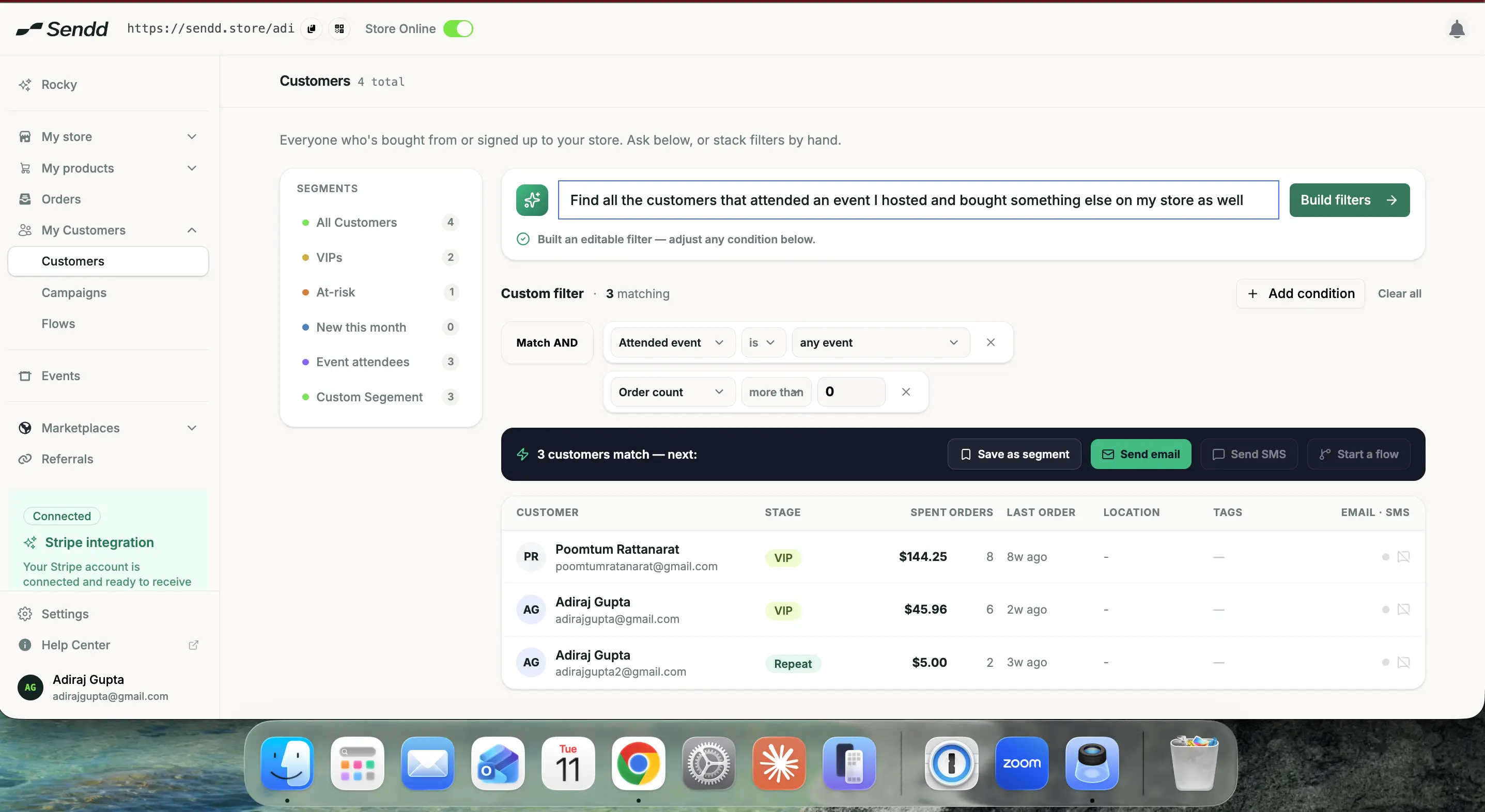 Rocky building a customer segment from a natural language query.
When is WooCommerce the right choice?
WooCommerce is right when control is the priority: custom functionality no hosted platform allows, full data sovereignty on your own server, deep WordPress content integration or fee minimisation at genuinely high volume.
Choose Sendd if you want to launch fast, spend nothing until you sell, avoid ever thinking about hosting or plugins, and get email, segmentation and AI built in.
Choose WooCommerce if you have technical capability in the team, need custom code-level control, run on WordPress already, or sell at a volume where 0% platform fees beat every managed option.
How do you migrate from WooCommerce to Sendd?
Export your products, customers and orders from WooCommerce as CSV, rebuild the catalogue on Sendd, connect Stripe, point your domain and set redirects.
- Export from WordPress admin. Products, customers and orders all export natively as CSV. Back up your media library for product images.
- Import into Sendd. Recreate products with variants and pricing. Keep names and descriptions consistent for SEO continuity.
- Connect payments. Link your own Stripe account. NZ merchants can also switch on flat 30¢ bank transfer at checkout.
- Point your domain and redirect. Move your custom domain and set 301 redirects from old product URLs.
- Retire the stack. Cancel hosting, theme and plugin licences once everything is verified. That recurring bill is the migration’s payback.
The same portability rules apply in reverse. Own your domain, keep master product data and you can always return to WooCommerce if you later need its control.
FAQ
Is WooCommerce cheaper than Sendd? At low volume, no. A typical WooCommerce store costs about US$1,000 to $1,500 a year in hosting, themes and plugins whether you sell or not, while Sendd costs 1% of what you actually sell. At roughly US$10,000+ a month in sales, WooCommerce’s fixed-cost model becomes cheaper on pure fees, if you exclude the value of your maintenance time.
Does WooCommerce charge transaction fees? No. WooCommerce itself takes no percentage of sales on any setup. You pay your payment gateway’s standard processing rates, plus your fixed costs for hosting, themes and plugins. This is WooCommerce’s strongest cost advantage at scale.
Who maintains a WooCommerce store? You do, or someone you pay. Hosting performance, WordPress and plugin updates, security patching, backups and compatibility testing are the store owner’s responsibility. On Sendd the platform infrastructure is fully managed and updates ship to every store automatically.
Can Sendd match WooCommerce’s flexibility? Not at the code level, and it does not try to. WooCommerce lets you modify anything, which is its point. Sendd’s website builder, which rolled out in August 2026, targets the practical version of flexibility: a storefront you edit yourself that looks like your brand without owning a WordPress stack.
Does Sendd work with WordPress? Sendd is a standalone platform, not a WordPress plugin. If your content lives on WordPress, you can keep the blog on WordPress and run the store on Sendd under the same domain, linking between them.
Can AI run a Sendd store? Yes. Rocky handles customer analysis and marketing segmentation from natural language, and Sendd MCP is live in Claude’s connector directory so an AI assistant can operate the store directly.
The bottom line
WooCommerce is the right tool for merchants who want to be their own platform team, and the wrong default for everyone else. If your next hour is better spent on products and customers than on hosting and plugins, Sendd’s managed 1% is the cheaper deal in every way that counts.
Start selling for 1% with no subscription → Create your free Sendd store or try the fee calculator .
By Adiraj Gupta, founder of Sendd.
Competitor pricing checked against live pricing pages, 10 August 2026. Figures are illustrative and should be re-verified before acting on them. Full NZ fee breakdown across every platform: Ecommerce Fees in New Zealand (2026) . Platform-by-platform comparison with the other big hosted option: Sendd vs Shopify (2026) .
