
For a new or lean business, Sendd is usually the better launch platform in 2026: 1% per sale, no subscription and commerce, customer data, email marketing and AI segmentation built into one system. For a large established retailer with complex integrations and high volume, Shopify remains the safer choice because of its mature app ecosystem. The honest breakeven is roughly NZ$5,000 in monthly sales, and even past that point the decision is about integration versus ecosystem depth, not just fees.
Key takeaways
- Sendd charges a 1% platform fee per sale with no monthly subscription. Payment processing is separate through your own Stripe account, or flat 30¢ bank transfer in NZ.
- Shopify Basic costs US$29/month billed annually (US$39 monthly), with 0% added transaction fees when you use Shopify Payments.
- Below roughly NZ$5,000 in monthly sales, Sendd is cheaper on fees alone. Above that, the comparison shifts to what each platform includes.
- Sendd builds email marketing and segmentation natively, with 2,000 free monthly credits covering 500 contacts, priced at half or less of Klaviyo’s beyond that, with unlimited sends. Rocky, Sendd’s AI assistant, builds segments from natural language. On Shopify these are separate paid apps.
- Shopify wins on ecosystem maturity, third party apps and proven scale. If you need an unusual integration, Shopify probably has an app for it.
Contents: How much does each platform cost? · What the fee difference looks like in practice · Cost at every stage of growth · What Shopify’s monthly fee buys · What Sendd includes that Shopify sells as apps · Customising a Sendd store · Which platform is ready for AI commerce · When to choose Shopify · Switching from Shopify to Sendd · What to verify before committing · FAQ
How much does Sendd cost compared to Shopify?
Sendd costs 1% of each sale with no monthly subscription. Shopify costs a monthly subscription plus payment processing, starting at US$29/month for Basic when billed annually.
Here is the full picture as of August 2026:
| Sendd | Shopify Basic | Shopify Grow | Shopify Advanced | |
|---|---|---|---|---|
| Monthly subscription | $0 | US$29 (annual) / US$39 (monthly) | US$79 (annual) / US$105 (monthly) | US$299 (annual) / US$399 (monthly) |
| Platform fee per sale | 1% | 0% with Shopify Payments | 0% with Shopify Payments | 0% with Shopify Payments |
| Card processing (NZ, online) | Your own Stripe rate (2.7% + 30¢ for domestic cards) | 2.7% + 30¢ NZD | 2.5% + 30¢ NZD | 2.4% + 30¢ NZD |
| Bank transfer at checkout (NZ) | Flat 30¢, no percentage | Not offered as a standard checkout option | Not offered as a standard checkout option | Not offered as a standard checkout option |
| Third party gateway surcharge | None | 2% | 1% | 0.6% |
Figures checked 10 August 2026 against Shopify’s published pricing . Shopify Payments rates vary by region and card type.
Two things to be fair about. First, Shopify charges 0% added transaction fees when you use Shopify Payments, so its per-sale cost is pure processing. Second, Shopify’s higher plans buy you progressively cheaper card rates, which matters at volume.
The structural difference is on the other side of the table. Most ecommerce platforms only offer card rails. Sendd makes bank transfer a real checkout option in New Zealand, at a flat 30¢ per order with no percentage at all. On a $200 order, that is 30¢ instead of $5.70 in card fees. No Shopify plan offers this as a standard checkout option.
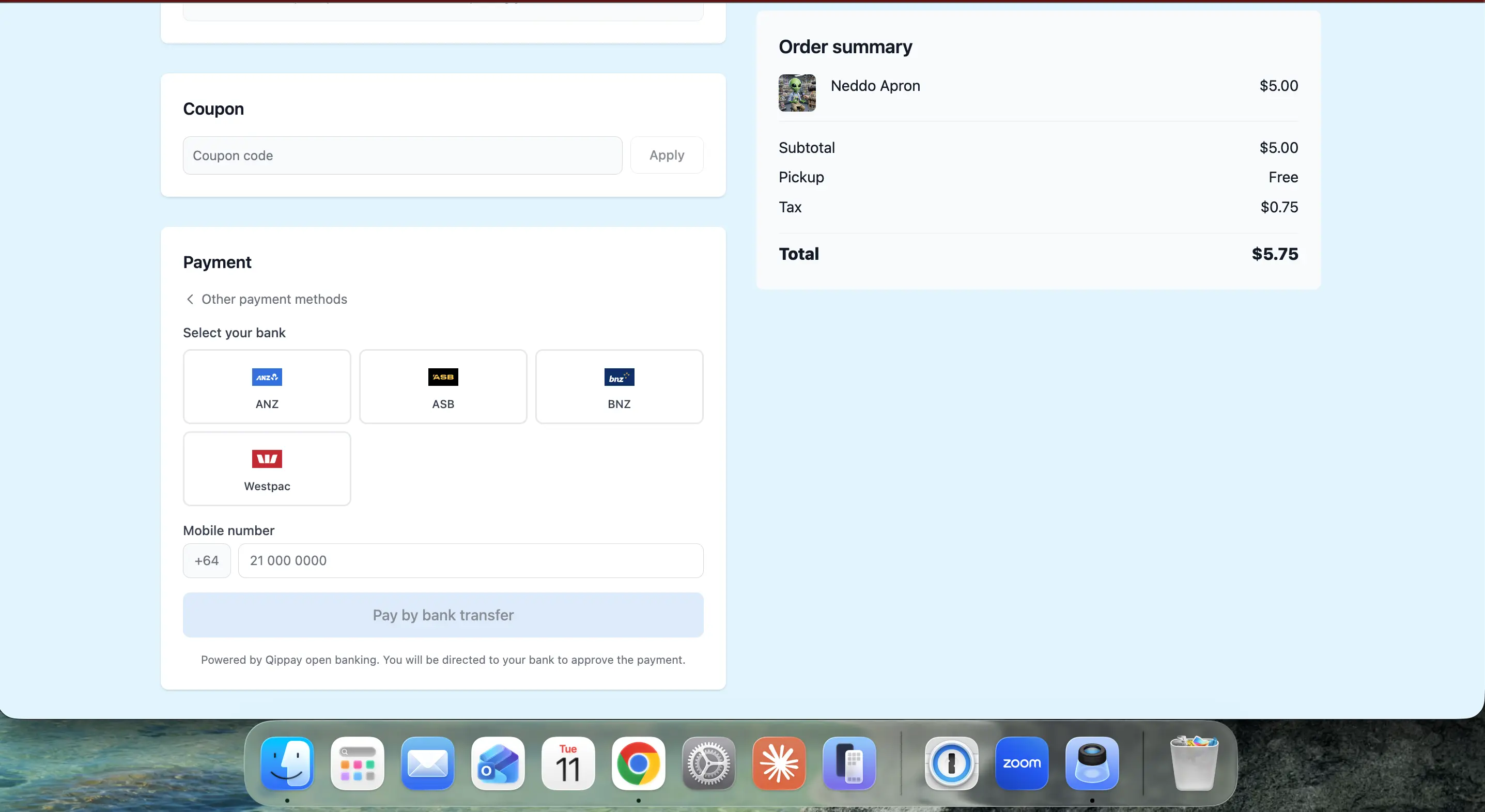 Sendd NZ checkout with bank transfer selected.
What does the fee difference look like in real numbers?
For a store doing NZ$2,000/month, Sendd costs about $20 in platform fees against roughly $48/month for Shopify Basic before any sale happens. For a store doing NZ$10,000/month, Shopify’s flat subscription starts to beat Sendd’s 1% on paper.
Worked example at NZ$5,000/month in sales, 50 orders at $100 each:
- Sendd, cards only: $50 platform fee (1%) + ~$150 Stripe processing = ~$200/month.
- Sendd, all bank transfer: $50 platform fee + $15 processing (50 × 30¢) = ~$65/month.
- Shopify Basic (annual): ~NZ$48 subscription + ~$150 processing (2.7% + 30¢) = ~$198/month.
On cards alone the totals are nearly identical at this volume. That is the honest maths. The gap opens in two directions. Below this volume, Sendd’s zero subscription means you pay almost nothing in a slow month, while Shopify’s subscription is due whether you sell or not. And wherever NZ customers choose bank transfer, the percentage disappears entirely.
There is a third direction the simple comparison misses: apps. One 2026 analysis of Shopify’s total cost of ownership found most mid-market brands spend US$350 to US$1,400 per month on apps alone (Commerce-UI, 2026). Email marketing, reviews, bundles and segmentation each tend to be a separate subscription on Shopify. That is where the next section matters.
Try both scenarios with your own numbers in the Sendd fee calculator .
What does each platform cost at every stage of growth?
Total monthly platform cost, assuming NZ$100 average order value, Shopify Basic billed annually (~NZ$48/month) and NZ card rates of 2.7% + 30¢:
| Monthly sales | Sendd (cards) | Sendd (bank transfer, NZ) | Shopify Basic (cards) |
|---|---|---|---|
| NZ$500 | ~$20 | ~$6.50 | ~$63 |
| NZ$2,000 | ~$80 | ~$26 | ~$108 |
| NZ$5,000 | ~$200 | ~$65 | ~$198 |
| NZ$10,000 | ~$400 | ~$130 | ~$348 |
| NZ$20,000 | ~$800 | ~$260 | ~$648 |
Includes platform fees plus payment processing. Excludes apps, themes and builds. Figures checked 10 August 2026.
Read the table honestly and three patterns fall out. On cards only, Shopify Basic becomes cheaper than Sendd somewhere around NZ$5,000/month and the gap widens with scale, before app costs. Below that line, Sendd wins and the gap widens the smaller you are, because a slow month on Sendd costs nearly nothing. And wherever NZ customers pay by bank transfer, Sendd stays cheaper at every volume in this table, because a flat 30¢ never scales with order value.
What do you get for Shopify’s monthly fee?
Shopify’s subscription buys you the most mature ecommerce infrastructure available: a proven checkout, thousands of themes, the largest app store in commerce and a global developer community. New Zealand’s online retail market reached NZ$7.4 billion in 2024 (MBIE ), and a meaningful share of it runs on Shopify.
That maturity is a genuine advantage. If your business eventually needs ERP integration, complex B2B wholesale pricing, multi-store international expansion or a niche piece of functionality, there is a strong chance Shopify already has an app, an integration or an agency that has solved it. Sendd cannot claim that depth. It launched publicly in January 2026 and now runs about 190 live stores, growing quickly but still early.
The trade is that Shopify’s depth is assembled, not included. A typical serious Shopify stack looks like: subscription + theme + email app + reviews app + bundles app + analytics + whatever else the business needs. NZ agencies quote NZ$10,000 to NZ$20,000 for a theme-based Shopify launch (Skyrocket, 2026 ). Each piece works, but you are the integrator, and each piece is a separate bill and a separate login.
What does Sendd include that Shopify sells as apps?
Sendd bundles the commerce backend, customer data, email marketing, segmentation and an AI assistant into one platform, so a new merchant is not assembling a stack of subscriptions.
The pieces live today:
- Native email marketing and customer segmentation. Build segments from purchase history, product views, spend and behaviour, then email them. Email is native to Sendd rather than a bolt-on, fed by the same live events stream Rocky reads, with 2,000 free credits monthly covering your first 500 contacts. Beyond it Sendd charges per contact with unlimited sends: US$50/month at 5,000 contacts against Klaviyo’s roughly US$100, and US$300 against roughly US$720 at 50,000, with no send caps against Klaviyo’s ~10x metering.
- Rocky, Sendd’s AI assistant. Rocky is an AI layer over your store’s customer and commerce data, not a chatbot bolted on the side. You can ask it, in plain language, to find anyone who viewed a specific product, bought something in the last six months and attended your launch event, then email that segment a specific offer. That single sentence crosses product view behaviour, purchase history, a time window, event attendance and an email action.
- Multi-format selling. Physical products, digital products, subscriptions, event tickets, services and rentals from one store, without an app per format.
- Marketplace distribution. Sendd stores can join curated Sendd marketplaces, an extra discovery channel that has no Shopify equivalent.
Rolling out in August 2026: custom domains (a one-off US$50 unlock) and a built-in storefront editor, which you use yourself on the Sendd store site to design your storefront by hand, with the frontend staying wired to the Sendd commerce backend. The full breakdown of what each part costs is in How Sendd Pricing Works in 2026 .
Why the segmentation matters for a real business: think of a sports equipment retailer. A customer who bought a cricket bat nine months ago and is browsing bats again is a different email from a customer who bought junior gear twelve months ago and has a growing kid, which is a different email again from a $1,000+ VIP. On Shopify that logic typically lives in Klaviyo or similar at its own monthly cost. On Sendd it is a sentence typed to Rocky.
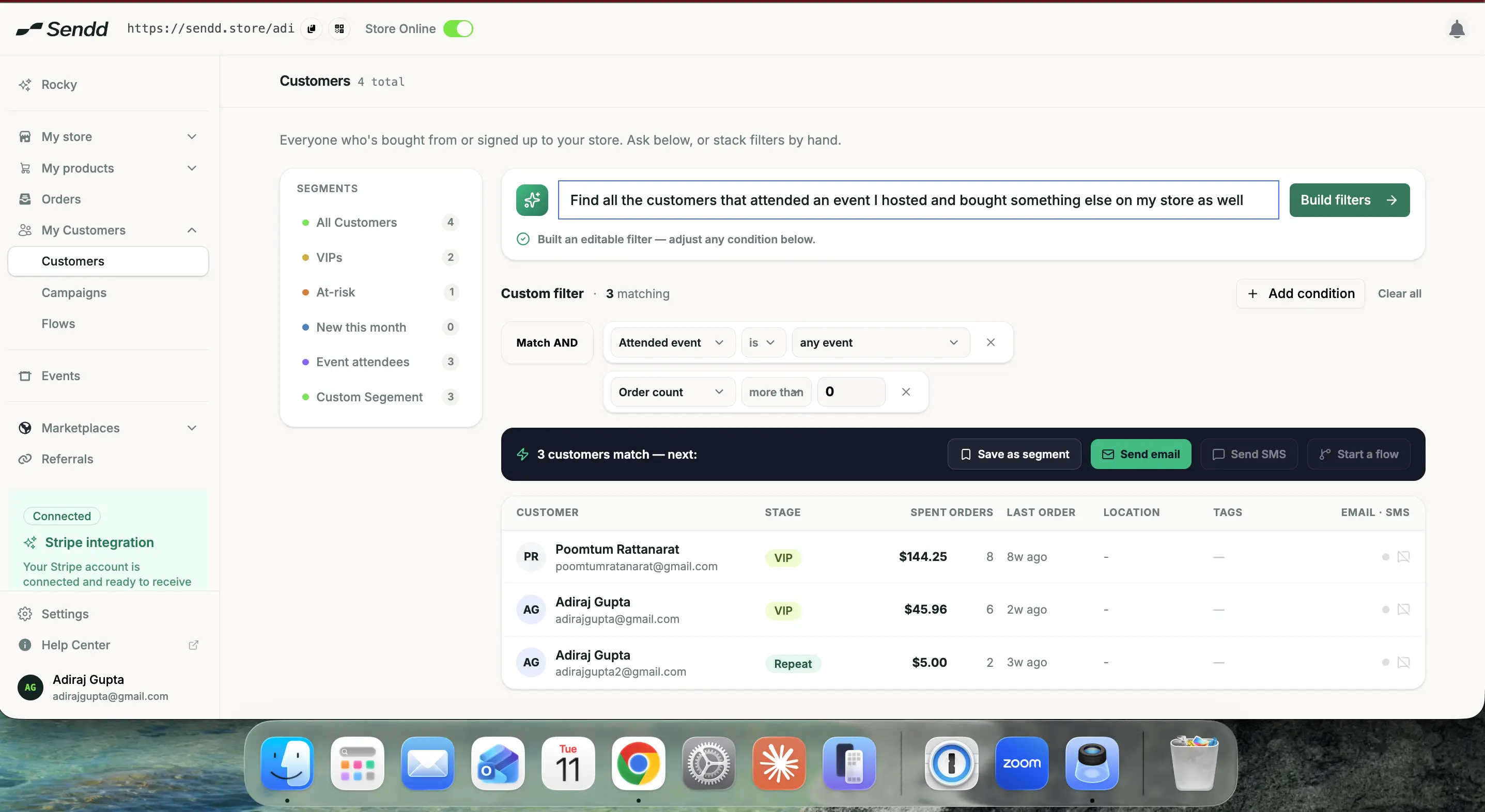 Rocky building a customer segment from a natural language query.
Can you customise a Sendd store like a Shopify store?
Increasingly, yes. Sendd’s August 2026 release adds custom storefronts built through an editor on the Sendd store site itself. You design the storefront by hand, with full editing control, and the frontend stays connected directly to the Sendd backend. The goal is a website that looks like your brand, not like a template, while Sendd manages the commerce infrastructure underneath.
Until that release is fully in your hands, the fair statement is that Shopify’s theming and customisation ecosystem is deeper today. Thousands of themes, Liquid templating and an enormous developer market mean almost any design is achievable on Shopify if you pay for it. Sendd’s bet is that a hands-on editor built straight into the platform gets a new brand to a distinctive site faster and far cheaper, without a NZ$10,000+ agency build.
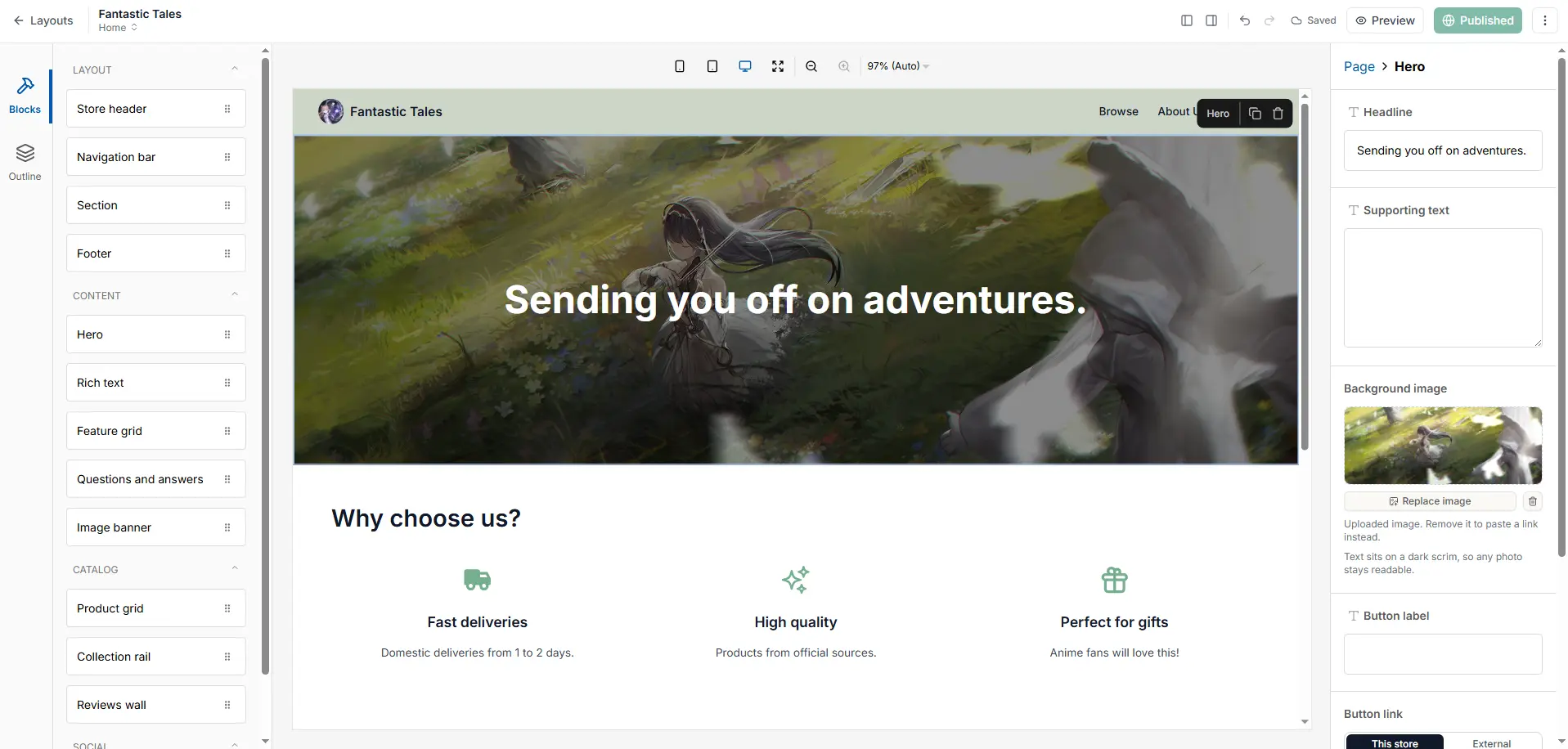 Editing a custom Sendd storefront design.
Which platform is more ready for AI commerce?
They are ready for different halves of it. Shopify is ahead on AI agents buying from you. Sendd is ahead on AI running your store. Both matter, and in 2026 most comparisons ignore the second half entirely.
AI commerce is splitting into two distinct capabilities.
Sell-side: AI agents shopping on your behalf. Shopify has moved aggressively here. It co-developed the Universal Commerce Protocol with Google in January 2026, launched a US$0/month Agentic Plan that syndicates any merchant’s catalogue into AI surfaces, and now connects merchants to ChatGPT, Google AI Mode, Gemini and Microsoft Copilot. The demand signal is real: Shopify reports AI-driven orders grew 15-fold in 2025 (Shopify, 2026) and its president says AI-referred traffic to merchants is up 7x since January 2025 (Weaverse, 2026). If your priority is being purchasable inside ChatGPT today, Shopify’s rails are more mature. That is a genuine advantage and it belongs in this comparison.
Operate-side: AI managing your business. This is Sendd’s ground. Sendd MCP is live in Claude’s connector directory, which means an AI assistant can operate your store directly: check orders, update products, analyse sales, act on your commerce data through natural language. Pair that with Rocky working over your customer data and the pitch is not “AI can buy from my store”, it is “AI helps run my store”. For a one-person or small-team business, an AI that does the marketing segmentation and store admin is worth more day to day than presence on an agent checkout surface that is still early for most product categories.
A quotable way to hold the distinction: Shopify is building rails for AI shoppers, Sendd is building rails for AI-run stores. As agent shopping matures, expect both platforms to cross into each other’s half. Today, pick based on which half your business needs first.
When should you choose Shopify instead of Sendd?
Choose Shopify if you are a high-volume established retailer, need complex third party integrations, run serious B2B or wholesale, manage thousands of SKUs or are expanding internationally across many markets.
Concretely, Shopify is the stronger choice when:
- Your volume is high enough that a flat subscription beats 1%, and your card rates are negotiated down on Advanced or Plus.
- You need ERP, 3PL, POS-heavy retail or other integrations where Shopify’s ecosystem is years ahead.
- You need specialised apps with no Sendd equivalent yet, such as advanced subscriptions logic, complex bundles or niche vertical tools.
- Platform risk matters more to you than platform cost. Shopify is a public company at global scale. Sendd is an early stage NZ company, and that is a real consideration, not a footnote.
If that list is not you yet, the case for paying Shopify’s assembly cost on day one is weak. The biggest problem for a new store is not “can the platform handle 50,000 orders”, it is “how do we get our first 100 customers”. A platform that costs $0 until you sell leaves more capital for stock, photography and ads.
The decision in one box:
Choose Sendd if you are launching or lean, want one integrated platform instead of a stack of app subscriptions, sell in NZ where bank transfer checkout cuts fees to 30¢ flat, or want AI running your marketing and store operations.
Choose Shopify if you are established and high volume, need deep third party integrations or specialised apps, run complex B2B or wholesale, or want to sell through AI shopping agents like ChatGPT checkout today.
How do you switch from Shopify to Sendd?
Switching takes an afternoon for a typical small catalogue: export your Shopify data, import products into Sendd, connect Stripe, point your domain and redirect your old URLs.
- Export from Shopify. Products, customers and orders all export as CSV from Shopify admin. Download everything, including images.
- Import into Sendd. Recreate your catalogue with variants, pricing and inventory. Keep your product names and descriptions consistent so returning customers and search engines recognise you.
- Connect payments. Link your own Stripe account. If you were on Shopify Payments, your payout history stays with Shopify, so download financial records first. NZ merchants can also switch on bank transfer at checkout.
- Point your domain. Unlock custom domains on Sendd (one-off US$50), move your custom domain across and set 301 redirects from your old URLs so your SEO equity follows you.
- Cancel Shopify last. Keep the Shopify account alive until you have verified every export, then downgrade. Annual plans cannot be cancelled mid-term, so time the switch to your renewal date.
The same steps run in reverse if you ever move the other way. That symmetry is the point of the portability section below.
What should you verify before committing to any platform?
Whichever platform you pick, keep your business portable: own your domain, keep master copies of product data and content, and confirm customer and order data can be exported.
A quick due diligence list that applies to Sendd, Shopify or anyone else:
- Domain: use your own custom domain, not a platform subdomain, so your SEO equity moves with you.
- Data export: confirm customers, orders and products export in a usable format. Sendd supports data export, and you can verify this before loading inventory.
- Content: keep independent copies of photography, copy and brand assets.
- Analytics: run your own Google Analytics and Meta Pixel alongside platform analytics. Sendd supports both natively.
The principle: the platform should be your infrastructure, not the owner of your business. Do this and Shopify remains an open migration path if you outgrow Sendd, and vice versa. The same question applied to your money is covered in Who Controls Your Payments?
FAQ
Is Sendd cheaper than Shopify? Usually, at startup scale. Sendd has no subscription and charges 1% per sale, so a quiet month costs almost nothing. Shopify Basic costs US$29 to US$39 per month regardless of sales. At roughly NZ$5,000/month in card sales the totals converge. Where NZ customers pay by bank transfer at 30¢ flat, Sendd stays cheaper well past that point.
Does Sendd process payments itself? No. Payment processing is always separate from Sendd’s 1% platform fee. You connect your own Stripe account and Stripe’s standard rates apply, or in New Zealand your customers can pay by direct bank transfer for a flat 30¢ per order. Outside New Zealand, Stripe is the payment option.
What is Rocky? Rocky is Sendd’s AI business assistant. It operates over your store’s actual commerce and customer data, so you can ask it in plain language to analyse customers, build marketing segments that combine behaviour, purchases and event attendance, and act on them, such as sending a targeted email offer.
Can I use my own domain on Sendd? Yes. Custom domains are rolling out in August 2026, with a one-off US$50 unlock fee reflecting the hard cost of connecting and securing them; there is no recurring domain charge from Sendd. Shopify includes domain connection in its subscription. On both platforms you buy the domain itself from a registrar.
Does Shopify charge transaction fees? Not when you use Shopify Payments, where you pay only card processing. If you use a third party payment gateway, Shopify adds a surcharge of 2% on Basic, 1% on Grow and 0.6% on Advanced on top of the gateway’s own fees.
Can I move from Sendd to Shopify later? Yes, if you keep your business portable: own your domain, keep master product data and confirm data export before you commit. Migration between ecommerce platforms is routine when the merchant owns their domain, content and customer data.
Can AI agents buy from a Sendd store or a Shopify store? Shopify is further ahead on agent checkout: its Universal Commerce Protocol and Agentic Plan connect merchants to ChatGPT, Gemini and Copilot shopping surfaces. Sendd is further ahead on AI operating the store itself, with Sendd MCP live in Claude’s connector directory and Rocky handling segmentation and marketing from natural language.
Does Sendd charge for email marketing? Email marketing is native to Sendd, and every merchant gets 2,000 free credits monthly, enough for 500 marketing contacts, double Klaviyo’s 250-profile free tier. Beyond it you pay per contact with unlimited sends: at 5,000 contacts Sendd costs US$50/month against Klaviyo’s roughly US$100, and the gap widens with scale, US$300 against roughly US$720 at 50,000 contacts. Klaviyo also caps sends at about 10x your profile count per tier while Sendd never meters your emails. On Shopify, email marketing is a separate app subscription.
Is Sendd only for New Zealand businesses? No. Sendd operates in NZ and the US, and the 1% fee with no subscription is the same everywhere. The flat 30¢ bank transfer option is NZ-specific. Merchants elsewhere use their own Stripe account for processing.
The bottom line
For a new or lean brand in 2026, Sendd is the stronger launch choice: 1% per sale, no subscription and commerce, customer data, email and AI segmentation in one integrated platform. Shopify remains the right call for large, complex, high-volume retailers who need its ecosystem depth. Start where your capital works hardest and keep your data portable.
Start selling for 1% with no subscription → Create your free Sendd store or try the fee calculator .
By Adiraj Gupta, founder of Sendd.
Competitor pricing checked against live pricing pages, 10 August 2026. Figures are illustrative and should be re-verified before acting on them. Full NZ fee breakdown across every platform: Ecommerce Fees in New Zealand (2026) .
