Sendd pricing has two parts and no subscription. Selling costs 1% of each sale, on every format, everywhere. Email marketing and Rocky, Sendd’s AI assistant, run on a shared credits system: every merchant gets 2,000 free credits a month, enough for 500 marketing contacts, and buys discounted credit packs beyond that. Payment processing is always separate, through your own Stripe account or flat 30¢ bank transfer in NZ. The design principle behind all of it: you pay when you earn, not before.
Key takeaways
- Sendd charges 1% per sale with no monthly subscription. A month with no sales costs $0.
- Payment processing is separate: your own Stripe account at Stripe’s rates, or direct bank transfer in NZ at a flat 30¢ per order with no percentage.
- Email and AI share one credits system: 2,000 free credits monthly, 4 credits per marketing contact, packs from $5 with volume discounts.
- At 5,000 contacts email costs US$50/month against Klaviyo’s roughly US$100, with unlimited sends against Klaviyo’s ~10x send cap.
- Most platforms charge before you sell (subscriptions) or scale their take with your success (high percentages, forced tier upgrades). Sendd’s 1% is the same on your first sale and your millionth.
What does Sendd charge to sell?
Sendd charges 1% of each sale. That is the platform fee: no monthly subscription, no listing fees, no plan tiers, no sales caps and the same rate for physical products, digital products, subscriptions, event tickets, services and rentals. The one one-off charge to know about: unlocking a custom domain on Sendd Store costs US$50, once, because connecting and securing custom domains carries a hard infrastructure cost that Sendd passes on at cost rather than folding into everyone’s fees. Your Sendd subdomain is free.
Payment processing is always separate from the 1%, and this matters for comparing honestly. You connect your own Stripe account and pay Stripe’s standard rates directly, so Sendd never marks up your processing. In New Zealand, your customers can also pay by direct bank transfer at checkout for a flat 30¢ per order with no percentage at all. Most ecommerce platforms only offer card rails; Sendd makes bank transfer a real checkout option in NZ. On a $200 order, that is 30¢ instead of roughly $5.70 in card fees.
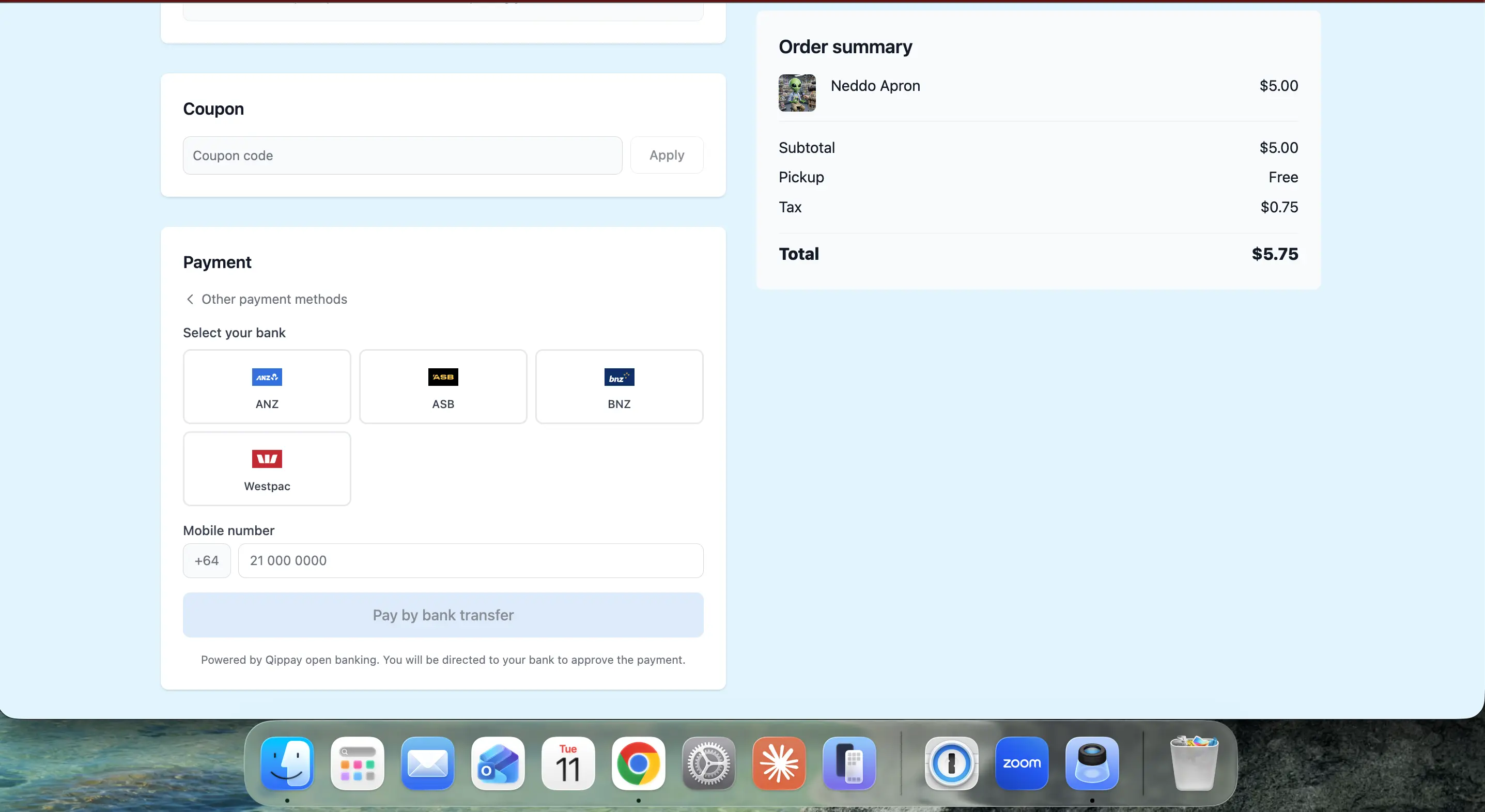 Sendd NZ checkout with bank transfer selected.
What are Sendd credits?
Sendd credits are one currency for everything beyond selling: email marketing and Rocky, Sendd’s AI assistant, draw from the same balance. Every merchant gets 2,000 free credits each month. A marketing contact costs 4 credits a month, so the free allowance covers 500 contacts, and Rocky’s usage draws from the same pool.
Beyond the free credits, you top up with packs starting at $5 for 1,000 credits, and packs get cheaper per credit as they get bigger. In practice that means a merchant with 5,000 email contacts pays about US$50 a month, a merchant with 50,000 pays about US$300 and a merchant with 100,000 pays about US$600, with sends never metered at any size.
One currency for email and AI is a deliberate design choice. Most platforms bill email marketing as one subscription, AI features as another and automations as a third. On Sendd a quiet month leaves credits for Rocky, a big campaign month spends them on contacts, and you buy one thing either way.
How does Sendd email pricing compare to Klaviyo?
At every list size, Sendd email costs half or less of Klaviyo’s price, and Sendd never caps your sends.
| Contacts | Sendd (credits) | Klaviyo email plan | Sendd as % of Klaviyo |
|---|---|---|---|
| 500 | Free (within monthly credits) | US$20 | 0% |
| 1,000 | ~US$10 | US$30 | 33% |
| 5,000 | ~US$50 | ~US$100 | 50% |
| 10,000 | ~US$75 | ~US$150 | 50% |
| 50,000 | ~US$300 | ~US$720 | 42% |
| 100,000 | ~US$600 | ~US$1,380 | 43% |
Klaviyo figures verified against multiple June 2026 sources; figures checked 10 August 2026.
The structural differences run deeper than price. Since February 2025 Klaviyo bills on active profiles, meaning every contact who could be emailed, whether you email them or not, and caps sends at roughly 10x your profile count per tier. Sendd charges per contact with unlimited sends: email your list daily or monthly, the price is the same. And Klaviyo’s fee buys email alone, while Sendd’s credits also power Rocky, which builds those very segments from natural language over your live customer data.
Klaviyo deserves its credit too: it is the deepest dedicated email platform in ecommerce, with predictive analytics and an integration ecosystem Sendd does not match. If your business is sophisticated lifecycle marketing above all else, Klaviyo’s premium can be worth it. For most merchants, email is a function of the store, not a second platform to run.
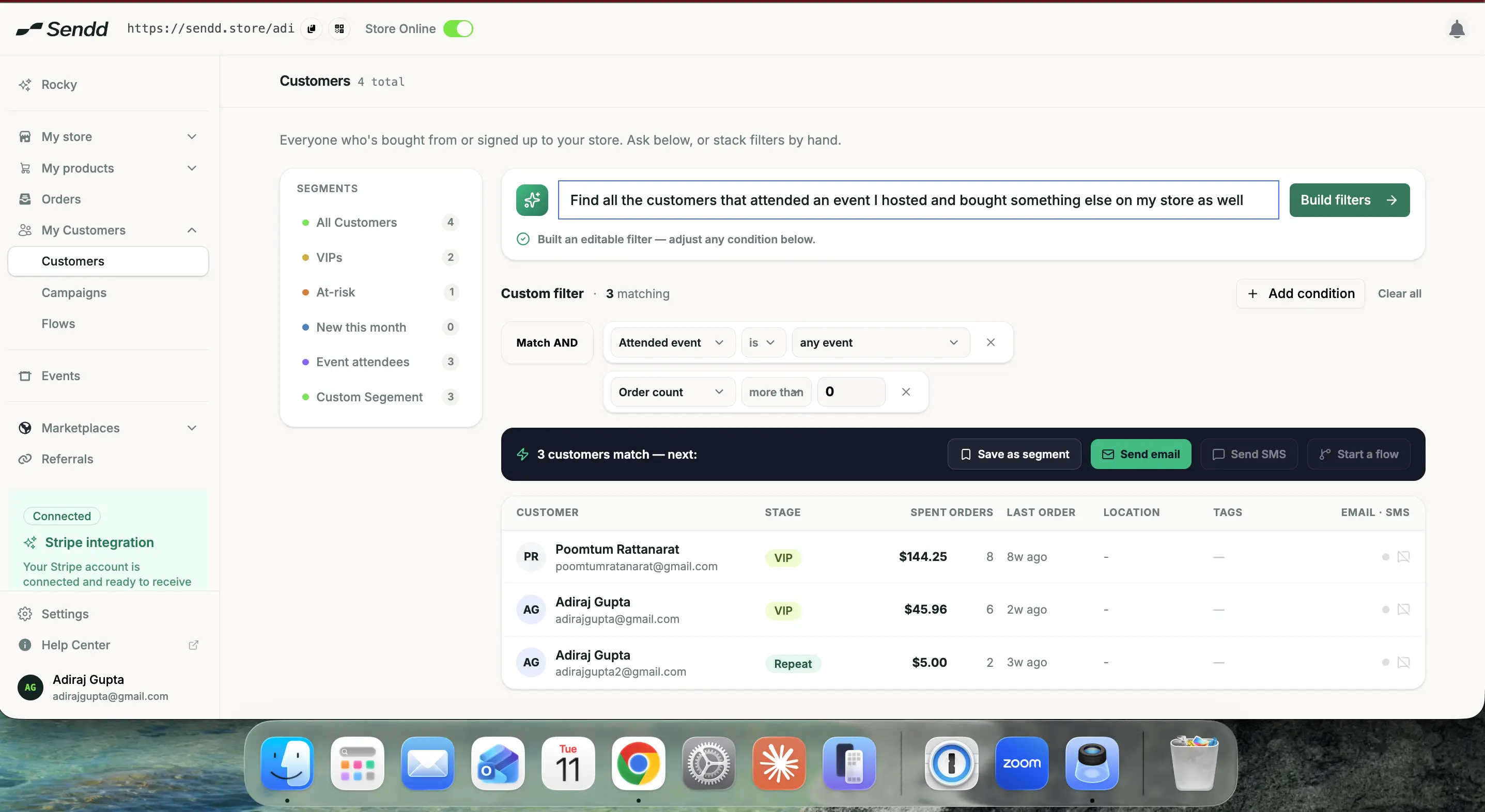 Rocky building a customer segment from a natural language query.
How does Sendd compare to other platforms’ pricing models?
Every ecommerce platform’s pricing answers one question differently: when do you pay? Sendd’s answer is after you earn. Most alternatives answer before, or increasingly as you succeed.
| Platform | Model | You pay before selling? | Cost scales how |
|---|---|---|---|
| Sendd | 1% per sale, no subscription | No | Proportionally with revenue, same rate forever |
| Shopify | US$29 to $2,300+/month + processing | Yes | Flat until you need bigger plans and apps |
| Gumroad | 10% + 50¢ per direct sale | No | 10x Sendd’s rate on every sale |
| WooCommerce | Free software, ~US$1,000+/year running costs | Yes | Fixed costs regardless of sales |
| Wix | US$29+/month for ecommerce | Yes | Flat plus app costs |
| Squarespace | US$16 to $99/month, 2% fee on entry plan | Yes | Flat plus digital-product fees up to 5% |
| BigCommerce | US$29 to $1,499+/month | Yes | Forced tier upgrades as sales cross thresholds |
Figures checked 10 August 2026 against each platform’s published pricing.
Read the middle column and the pattern is clear. Subscription platforms charge you during the months you are building, before revenue exists, which is precisely when capital matters most. Percentage platforms like Gumroad avoid that but take ten times Sendd’s rate. BigCommerce’s model is the most revealing: crossing roughly US$30,000 in trailing annual sales automatically upgrades your plan, so success raises your rent. Sendd’s rate never changes because you grew.
The full comparisons live in the sibling posts: Sendd vs Shopify, Sendd vs Gumroad, Sendd vs WooCommerce, Sendd vs Wix, Sendd vs Squarespace and Sendd vs BigCommerce.
Why does Sendd price this way?
Because a new business’s scarcest resource is capital before revenue, and pricing should not consume it. Sendd’s model is built on three commitments.
Pay when you earn. The 1% only exists when a sale does. Software subscriptions are a bet you place before knowing whether the business works; a revenue share is a cost that cannot arrive before the revenue does.
No punishment for success. No sales caps, no forced upgrades, no tier cliffs. 1% of your first $100 and 1% of your millionth dollar. The platforms that step their pricing as you grow are charging you for succeeding on their infrastructure.
No margin on your money’s movement. Payment processing passes through at your own Stripe rates, and NZ bank transfer costs what it costs: 30¢. Plenty of platforms quietly earn on processing spreads; Sendd’s earnings are the visible 1% and credits, nothing hidden in the rails. Where a real one-off cost exists, like enabling a custom domain, it is charged once at US$50 and named, not buried.
The honest trade-off deserves stating: at high volume, flat subscriptions can beat a percentage on pure fees. A store doing US$50,000 a month pays Sendd $500 while a Shopify Basic subscription is about US$39. What the subscription platforms leave out of that maths is everything else on the bill, since email, apps and features arrive as separate subscriptions there, and mid-market Shopify stacks commonly run US$350 to US$1,400 a month in apps alone (Commerce-UI, 2026). Compare totals, not headline rates, and run your own numbers in the fee calculator .
FAQ
Does Sendd have a monthly fee? No. Sendd has no subscription for selling. You pay 1% of each sale, so a month with no sales costs nothing. Email beyond your free monthly credits and additional Rocky usage are the only things you can pay for monthly, and both are optional credit top-ups, not subscriptions.
What do Sendd credits pay for? Credits are one shared currency for email marketing and Rocky, Sendd’s AI assistant. Every merchant gets 2,000 free credits monthly. Marketing contacts cost 4 credits each per month, so free credits cover 500 contacts, and credit packs from $5 top you up with volume discounts as packs get bigger.
Is payment processing included in the 1%? No, and it is not included in any platform’s fee. Sendd merchants pay Stripe’s standard rates through their own Stripe account, with no Sendd markup. In New Zealand, customers can instead pay by bank transfer at checkout for a flat 30¢ per order.
How is Sendd email cheaper than Klaviyo with unlimited sends? Sendd charges per contact through credits and never meters sends, while Klaviyo bills on active profiles with a send cap of roughly 10x your profile count per tier. At 5,000 contacts Sendd costs about US$50 against Klaviyo’s roughly US$100; at 50,000 it is about US$300 against roughly US$720.
Does the 1% apply to every product type? Yes. Physical products, digital downloads, subscriptions, event tickets, services, bookings and rentals all carry the same 1% with no format surcharges.
Does Sendd charge for custom domains? Yes, a one-off US$50 to unlock a custom domain on your store. It reflects the hard cost of connecting and securing custom domains, passed on once rather than built into every merchant’s fees. There is no recurring domain charge from Sendd; you pay your registrar for the domain itself, as on any platform. Your Sendd subdomain is free.
When is Sendd not the cheapest option? At high card-sales volume, a flat subscription can beat 1% on platform fees alone: past roughly NZ$5,000 a month, Shopify Basic’s subscription costs less than 1% of sales. Whether it costs less in total depends on the apps a comparable stack needs and on whether NZ bank transfer applies to your customers. Honest comparison beats headline rates.
The bottom line
Sendd’s pricing is one number you can hold in your head, 1% when you sell, plus one currency, credits, for email and AI, with generous free allowances of both. Everything else in the market either bills you before revenue exists or raises your rate for growing. Pick the model that matches the shape of a new business: costs that arrive with income, not ahead of it.
Start selling for 1% with no subscription → Create your free Sendd store or try the fee calculator .
