
Squarespace is the design-first website builder, and it charges for that in layers: US$16/month on Basic plus a 2% transaction fee on sales, or US$23/month on Core to remove the fee on physical products, with digital product sales still charged up to 5%. Sendd charges 1% per sale with no subscription on every format. If your site is a portfolio or brand presence that occasionally sells, Squarespace’s templates justify the price. If your site exists to sell, Sendd is cheaper at typical small-business volume and includes the commerce and marketing tooling Squarespace gates behind higher tiers.
Key takeaways
- Squarespace’s 2026 lineup runs Basic US$16, Core US$23, Plus US$39 and Advanced US$99 per month billed annually.
- The Basic plan adds a 2% transaction fee on sales, and digital content carries separate fees of up to 5% even on Core.
- Sendd charges a flat 1% on every sale in every format with no subscription, plus your own Stripe processing, or 30¢ flat bank transfer in NZ.
- Squarespace does not support multi-currency selling and gates abandoned cart and subscriptions behind higher plans.
- Squarespace wins on out-of-the-box template polish. Sendd wins on cost, formats, marketing tooling and AI.
Contents: How much selling on Squarespace really costs · Where the cost crossover sits · What Sendd sells that Squarespace cannot · Whether Sendd can match Squarespace’s design · When to pick Squarespace · Moving from Squarespace to Sendd · FAQ
How much does selling on Squarespace really cost?
Squarespace’s four 2026 plans cost US$16 (Basic), US$23 (Core), US$39 (Plus) and US$99 (Advanced) per month billed annually, and the commerce features are spread unevenly across them (Startup Launch Page, 2026 ). Basic adds a 2% transaction fee on sales. Core removes it for physical products but digital content and memberships still carry a 5% fee, dropping to 1% on Plus (LitExtension, 2026 ). Abandoned cart recovery and subscription selling arrive only at Plus and above.
| Sendd | Squarespace Basic | Squarespace Core | Squarespace Plus | |
|---|---|---|---|---|
| Monthly subscription | $0 | US$16 (annual) | US$23 (annual) | US$39 (annual) |
| Fee on physical sales | 1% | 2% | 0% | 0% |
| Fee on digital sales | 1% | up to 7% | 5% | 1% |
| Card processing | Your own Stripe rate | ~2.9% + 30¢ | ~2.9% + 30¢ | ~2.9% + 30¢ |
| Bank transfer at checkout (NZ) | Flat 30¢ | Not offered as a standard checkout option | Not offered | Not offered |
| Abandoned cart recovery | Included | No | No | Yes |
| Multi-currency | Via Stripe | Single currency | Single currency | Single currency |
Figures checked 10 August 2026 against Squarespace’s published pricing following its late 2025 plan overhaul.
The genuine Squarespace advantages: its templates are the most polished in the industry out of the box, the editor produces professional results without code, and from Core upward physical product sales carry no platform percentage at all, which beats Sendd’s 1% on pure fee structure once your volume covers the subscription.
The catches are structural. Digital sellers pay a percentage on every plan below Advanced. Squarespace runs stores in a single fixed currency with no multi-currency support (StartupOwl, 2026 ). And the features that actually recover revenue, abandoned cart and subscriptions, cost US$39/month before you start.
Where is the cost crossover?
For physical products, Squarespace Core beats Sendd on platform fees above roughly US$2,300/month in sales. For digital products, Sendd is cheaper at every volume below Advanced, because Squarespace’s digital fee is 5x Sendd’s.
| Monthly sales | Sendd (any format) | Squarespace Basic (physical) | Squarespace Core (physical) | Squarespace Core (digital) |
|---|---|---|---|---|
| $500 | $5 | $26 | $23 | $48 |
| $1,000 | $10 | $36 | $23 | $73 |
| $2,300 | $23 | $62 | $23 | $138 |
| $5,000 | $50 | $116 | $23 | $273 |
| $10,000 | $100 | $216 | $23 | $523 |
Platform subscription plus platform transaction fees only. Processing applies similarly on both. Figures checked 10 August 2026.
Read it honestly: a pure physical-product store doing solid volume is cheaper on Squarespace Core than on Sendd, and that deserves saying plainly. The picture flips for digital products, mixed-format businesses and small stores, and it flips hardest in NZ, where Sendd’s flat 30¢ bank transfer option removes percentage processing entirely on those orders.
Run your mix in the Sendd fee calculator.
What can Sendd sell that Squarespace cannot?
Sendd sells physical products, digital products, subscriptions, event tickets, services, bookings and rentals natively in one store at 1%. On Squarespace, subscriptions require the Plus plan, digital products carry extra fees, and formats like rentals need workarounds or third party tools.
Squarespace grew from websites toward commerce; the commerce layer is capable but shows its origins. Multi-currency is absent, the payment gateway list is short (Stripe, PayPal and Squarespace Payments) and B2B or wholesale pricing has no native support (Startup Launch Page, 2026 ). Sendd grew from commerce toward websites, which is why every format is a first-class type with one customer list behind it.
Sendd stores can also join curated Sendd marketplaces , an extra discovery channel with no Squarespace equivalent.
Can Sendd match Squarespace’s design?
Squarespace’s templates are better out of the box today, and pretending otherwise would be dishonest. Sendd’s answer is the website builder that rolled out in August 2026: an editor on the Sendd store site where you design your storefront by hand, with full editing control, connected directly to the Sendd commerce backend.
The design question is really a control question. Squarespace gives you beautiful templates within their grid. Sendd hands you the editor and the keys, so the storefront looks like your brand rather than a shared template. For a brand-conscious small business, either path gets you a professional site; only one of them charges you a subscription while you decide.
Behind the storefront, the marketing engine differs more sharply. Sendd’s email marketing and segmentation are native, with 2,000 free monthly credits covering 500 contacts, priced at half or less of Klaviyo’s beyond that, with unlimited sends, and Rocky, its AI assistant, builds segments from natural language: find everyone who viewed a product, bought in the last six months and attended your launch event, then email them an offer. Squarespace Email Campaigns is a separate paid add-on and nothing in it queries customer behaviour conversationally. Sendd MCP is also live in Claude’s connector directory for AI-operated store management.
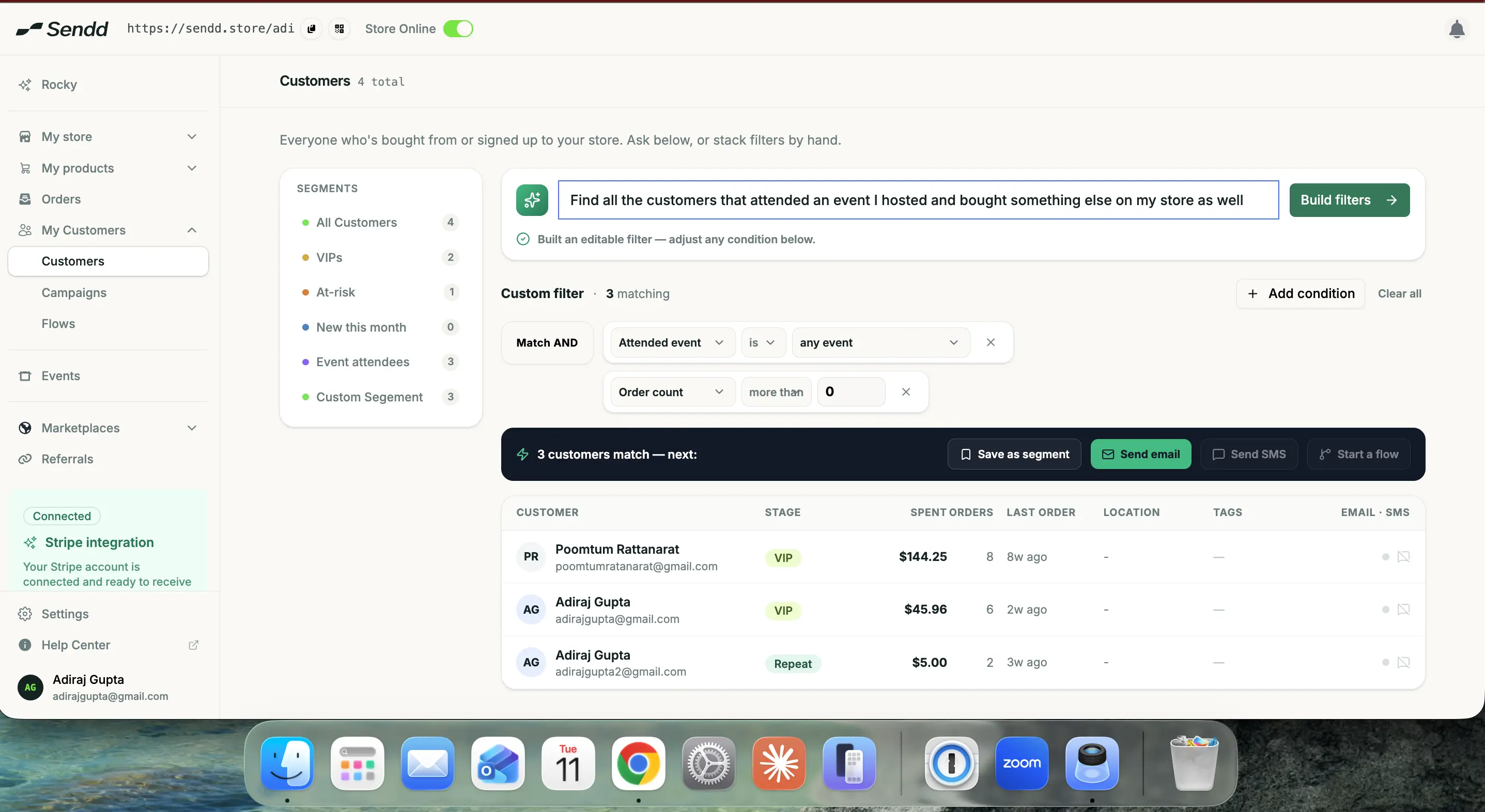 Rocky building a customer segment from a natural language query.
When should you pick Squarespace?
Pick Squarespace when the site is primarily a brand, portfolio or content property, commerce is a side function, and template polish out of the box matters more than commerce depth or fees.
Choose Sendd if revenue is the site’s job, you sell digital products or mixed formats, you sell in NZ where bank transfer cuts fees to 30¢ flat, or you want native email, segmentation and AI without another platform subscription.
Choose Squarespace if you need the most polished templates today, sell physical products at volumes that cover the Core subscription, and are comfortable with single-currency selling.
How do you move from Squarespace to Sendd?
Export products and contacts from Squarespace as CSV, rebuild on Sendd, connect Stripe, then move your domain with redirects.
- Export from Squarespace. Products and customer data export as CSV. Download product images at full size.
- Rebuild on Sendd. Keep product names, descriptions and pricing consistent for returning customers and SEO.
- Connect your own Stripe. Or enable NZ bank transfer at checkout for the flat 30¢ option.
- Move the domain. Point your custom domain at Sendd and set 301 redirects from old URLs.
- Cancel at renewal. Squarespace annual plans are prepaid, so time the move to your billing date.
FAQ
Does Squarespace charge transaction fees? Yes, on the Basic plan: 2% on sales, and up to 7% on digital content. Core and above remove the fee on physical products, but digital content still carries 5% on Core and 1% on Plus. Payment processing of about 2.9% + 30¢ applies on all plans. Sendd charges a flat 1% on every format plus your own Stripe processing.
Is Sendd cheaper than Squarespace? For digital products, mixed formats and small stores, yes at every realistic volume. For pure physical-product stores, Squarespace Core’s 0% platform fee beats Sendd’s 1% once monthly sales exceed roughly US$2,300, before add-ons. NZ bank transfer at 30¢ flat shifts the maths further toward Sendd for NZ merchants.
Can Squarespace sell subscriptions and digital downloads? Yes, with conditions: subscription selling requires the Plus plan at US$39/month, and digital content carries platform fees of 1% to 7% depending on tier. Sendd sells both at 1% with no subscription.
Does Squarespace support multiple currencies? No. Squarespace stores display and charge in one fixed currency set by the owner. Sendd merchants process through their own Stripe account, which supports multi-currency payment.
Is Squarespace easier to design than Sendd? Out of the box today, Squarespace’s templates are the industry’s most polished and that is its core strength. Sendd’s website builder, which rolled out in August 2026, lets you design a custom-branded storefront by hand, connected to the Sendd backend, rather than starting from a shared template.
Can AI run a Sendd store? Yes. Rocky builds customer segments and marketing actions from natural language over your live commerce data, and Sendd MCP is live in Claude’s connector directory so an AI assistant can operate the store directly.
The bottom line
Squarespace makes beautiful websites that can sell. Sendd makes selling machines that can now look beautiful too. If your business is the site, pay for Squarespace’s polish. If your business is the sales, keep the subscription money and pay 1% only when revenue actually arrives.
Start selling for 1% with no subscription → Create your free Sendd store or try the fee calculator.
By Adiraj Gupta, founder of Sendd.
Competitor pricing checked against live pricing pages, 10 August 2026. Figures are illustrative and should be re-verified before acting on them. Full NZ fee breakdown across every platform: Ecommerce Fees in New Zealand (2026) . Compare the other website builder: Sendd vs Wix (2026) , or the biggest hosted platform: Sendd vs Shopify (2026) .
