
On most ecommerce platforms, you don’t own your payment processor. The platform does. It sets your rate, holds your funds, controls your payout schedule and decides whether you get paid.
That’s not a bug. It’s how Shopify Payments, Etsy Payments, Square, Amazon and eBay are built. The alternative is connecting your own Stripe account, where your funds settle directly to your bank and the platform never touches your money. This article breaks down how each model works, what the documented risks are and which platforms let you choose.
Key takeaways
- There are three payment models in ecommerce: managed platform payments (Shopify, Etsy, Square, Amazon), bring-your-own-processor like Sendd (you connect your own Stripe), and Merchant of Record (Gumroad, Lemon Squeezy).
- The biggest documented risk of managed payments is held funds. Shopify has frozen $17k–$55k in merchant balances for months. Etsy’s reserve policy currently withholds up to 30% of revenue for up to 45 days (originally 75% when introduced). A WooPayments seller had payouts suspended for roughly eight months despite fulfilling every order.
- Platforms name rapid sales growth as a hold trigger in their own policy documents. Etsy, WooPayments, eBay and PayPal all flag “sudden increases in sales” as a reason to freeze funds.
- Shopify charges a 0.5%–2% surcharge if you use your own Stripe instead of Shopify Payments. BigCommerce introduced a similar 0.6%–2% Open Payment Provider Fee in June 2026. Both financially penalise merchants for wanting processor independence.
- Sendd is payment agnostic. Instead of forcing you through a platform-controlled processor, Sendd lets you choose how you get paid: connect your own Stripe account, accept bank-to-bank payments in NZ, or both. Sendd charges a flat 1% separately and never holds your funds. If you leave, your payment accounts and their history come with you.
- Owning your own Stripe doesn’t eliminate all payment risk. Stripe can still hold or close accounts. What own-Stripe removes is the second, platform-controlled layer of withholding on top.
Contents: The three payment models · Who owns what · The documented cost of managed payments · Growth triggers fund freezes · Platform-by-platform breakdown · Payment-agnostic processing · FAQ
What are the three payment models in ecommerce?
Every ecommerce platform handles payments in one of three structurally different ways. The difference decides who legally holds your revenue, who owns the customer and payment data, who carries fraud and chargeback losses, and who controls when you get your cash.
Managed platform payments. The platform is the payment processor. Shopify Payments, Etsy Payments, Wix Payments, Squarespace Payments, Square, Amazon and eBay all work this way. You never hold a direct relationship with the processor. The platform onboards you, sets your blended rate, holds the funds in its system and pushes payouts on its schedule.
Bring-your-own-processor. The commerce platform is payment agnostic. Instead of forcing you through a platform-controlled processor, it lets you choose how you get paid. You hold your own Stripe account in your own legal name. The platform routes the charge into your Stripe. Stripe underwrites you, settles to your bank and governs your money. The platform takes no cut of processing. Sendd works this way: a flat 1% platform fee, no subscription, no processing markup. In New Zealand, Sendd also connects into domestic bank-to-bank payment rails at a flat 30¢. WooCommerce (via the separate Stripe plugin) also supports own-processor with no platform percentage fee, though you pay for self-hosting (~$90–105/month all-in). Ko-fi supports own Stripe/PayPal with a 5% platform fee on shop sales (or 0% on the $12/month Gold plan).
Merchant of Record (MoR). A third party becomes the legal seller to the customer, taking on payments and liabilities (sales tax, VAT, PCI, refunds, chargebacks) in exchange for a larger cut. Gumroad, Lemon Squeezy, Paddle and FastSpring work this way. The customer’s receipt shows the MoR’s name, not your brand.
Who actually owns what under each model?
This is the table that makes the structural difference concrete.
| Dimension | Managed (Shopify, Etsy, etc.) | Own Stripe (Sendd) | Merchant of Record (Gumroad, etc.) |
|---|---|---|---|
| Who holds money before payout | The platform | You (Stripe settles to your bank; Sendd never holds it) | The MoR |
| Who owns customer and payment data | The platform (limited portability) | You (your Stripe vault, exportable) | The MoR (it’s the customer of record) |
| Who carries chargeback/fraud risk | You, but the platform controls the tooling | You, and you own the direct controls | The MoR absorbs it |
| Who controls payout timing | The platform (schedules, reserves, holds) | You and Stripe (standard, instant, your schedule) | The MoR (often net-X or monthly) |
| Whose name is on the receipt | Usually your brand | Your brand | The MoR’s name |
| Can you negotiate the processing rate? | No (blended rate, set by plan tier) | Yes (Stripe volume pricing, IC+, custom deals) | No (MoR sets the all-in rate) |
The key line is the first one. On managed platforms, the platform holds your money before paying you. On own-Stripe, you hold it. That single difference is the root cause of every fund-hold story in this article.
What does it actually cost when a platform controls your payments?
The documented cost shows up in three ways: held funds, forced processor penalties and lost portability.
Held funds
When the platform controls your payment processor, it also controls your money. This isn’t theoretical. It’s documented, named and ongoing.
Shopify. In 2026, merchants on Shopify Community forums report payout holds lasting three weeks to six weeks . Documented cases include balances of $17,000 to $55,000 frozen with no clear timeline for release. One merchant had funds held by Shopify’s legal team for 130+ days , ten days beyond the stated 120-day hold period, before eventually receiving payment. Shopify continued billing the annual subscription during the hold.
Etsy. Etsy’s reserve policy withholds up to 30% of funds from each sale for up to 45 days. Reserves originally withheld 75% of revenue when introduced, and were reduced to 30% after significant seller backlash. Etsy’s own documentation lists “a sudden sharp increase in sales” as a reason for placing reserves, and sellers have no visibility into the specific reason their account was flagged.
WooPayments. A seller who went viral (approximately 8 million views) had payouts suspended for roughly eight months on WooPayments despite fulfilling every order. WooPayments creates a “Stripe Express” sub-account, a restricted account type, not a regular Stripe account. The merchant had no direct relationship with Stripe to escalate through.
PayPal. PayPal’s reserve policy can withhold up to 100% of transactions for up to 180 days, triggered by preselling, delivery windows and velocity flags. High-profile cases include manufacturers having six- and seven-figure sums frozen after rapid growth.
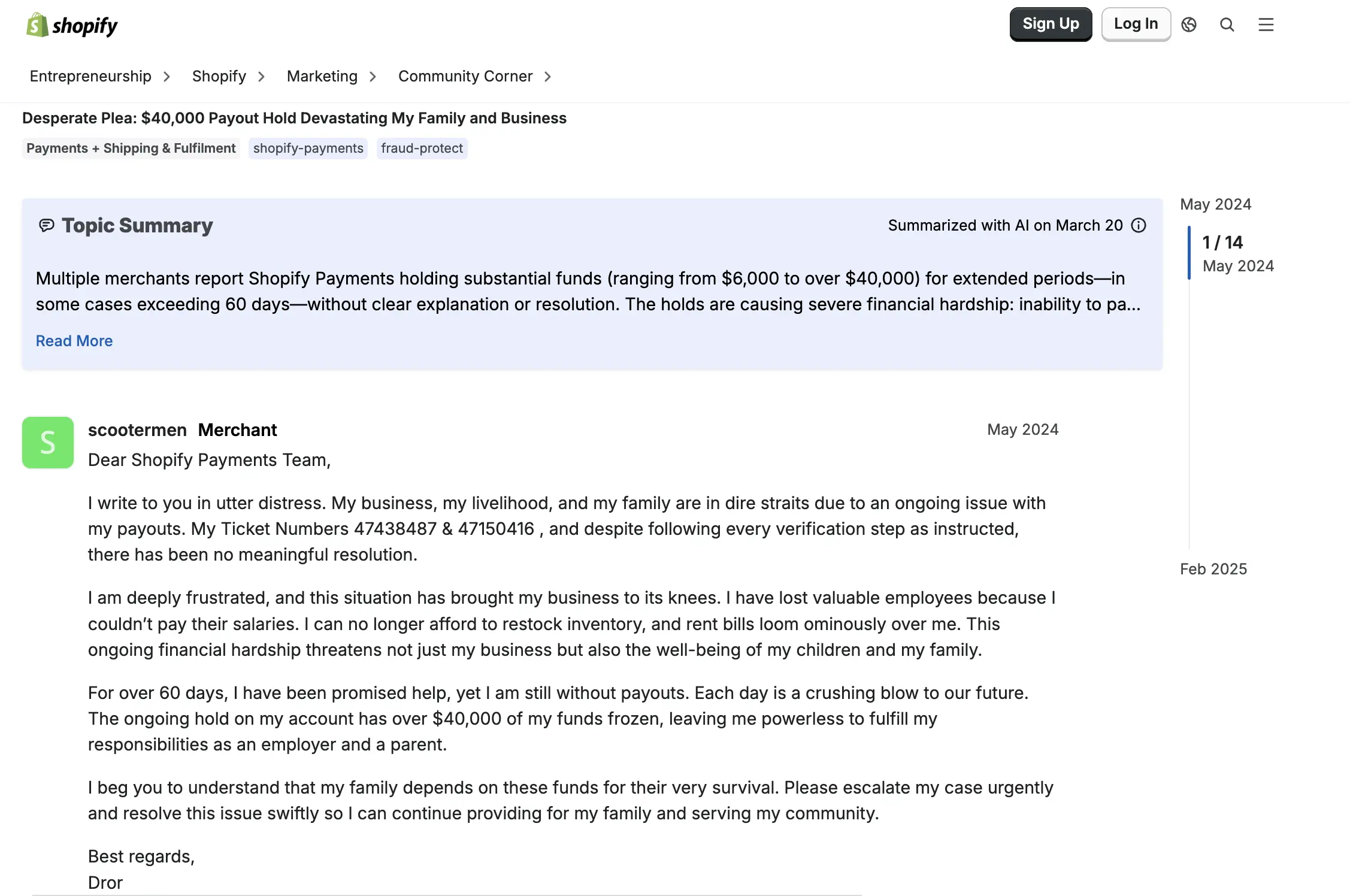
Shopify Community: “$40,000 Payout Hold Devastating My Family and Business” — a merchant describes losing employees and being unable to restock after 60+ days of frozen funds.
Forced processor penalties
Two major platforms now financially penalise merchants for wanting to use their own payment processor.
Shopify charges an additional 2.0% (Basic), 1.0% (Grow), 0.6% (Advanced) or 0.2% (Plus) on every transaction processed through a third-party gateway instead of Shopify Payments. On $1 million in annual sales on the Basic plan, that’s roughly $20,000 per year as a surcharge for processor independence.
BigCommerce introduced its Open Payment Provider Fee on June 1, 2026 , charging 2.0% (Core), 1.0% (Growth) or 0.6% (Scale) of GMV for using any payment provider not on its approved “Embedded” list. This is particularly notable because “no transaction fees” was BigCommerce’s primary competitive argument against Shopify for years. That argument is now gone.
Lost portability
When the platform owns your processor, your payment history, saved cards and subscription billing relationships are tied to that platform. If you leave Shopify, your Shopify Payments transaction history doesn’t transfer. If you leave Etsy, you have no independent processor to take with you. If you leave Gumroad, the MoR owns the customer billing relationship.
On own-Stripe platforms, your Stripe account is yours. Your transaction history, saved customer cards, active subscriptions and processor relationship come with you. Stripe also supports migrating card data between Stripe accounts if you move to a different commerce platform.
Why does growth trigger fund freezes?
This is the pattern the platforms admit to in their own documentation, and it’s the one most likely to affect a growing seller.
Etsy lists “a sudden sharp increase in sales” as a reserve trigger in its payment policy.
WooPayments states reserves may apply when there is “an unexplainable sharp increase in order volume.”
eBay documents the trigger with a physical-maker example: “a large spike in sales.”
PayPal ties reserves to “preselling,” delivery windows and velocity, with holds reaching up to 100% for up to 180 days.
The structure is the same across all four: the platform sees rapid growth, flags it as potential fraud risk, and freezes first. The merchant then needs to prove legitimacy while their cash flow is frozen.
Here’s what that looks like in practice. Your product goes viral on TikTok or Instagram. Orders spike from 20 a day to 500. Instead of celebrating, you get a notification that your funds are on hold pending review. You can’t restock inventory, you can’t pay suppliers and you can’t fulfil the orders that are still coming in. The moment your business breaks through is the exact moment the platform freezes your money.
This is why payment-agnostic platforms like Sendd become so powerful for high-growth businesses. On a platform-controlled processor, growth is a risk flag. On your own Stripe account, growth is just growth. Stripe still conducts its own risk reviews, but you have a direct relationship with them, can escalate directly and aren’t subject to a second layer of platform-level withholding on top. Your fastest month doesn’t become your most dangerous one.
How does each platform handle payment processor ownership?
Here’s the full breakdown across every major ecommerce platform, sorted by how much control you have over your payments.
Full processor ownership (no penalty)
Sendd. Payment agnostic by design. Instead of forcing you through a platform-controlled processor, Sendd lets you choose: connect your own Stripe account for cards and wallets, connect Qippay for bank-to-bank payments in NZ, or both. Sendd charges 1% separately, never holds funds, no surcharge. Bank transfer processing in NZ is a flat 30¢ with no percentage. You control your own payout schedule. If you leave, your payment accounts come with you. See Ecommerce Fees in NZ (2026) for the full cost comparison.
WooCommerce (Stripe plugin). Connect your own full Stripe account directly. True processor ownership with no surcharge. Requires self-hosting: server, SSL, security, updates and extension licensing (realistic all-in cost ~$90–105/month). The cleanest incumbent on this axis, but the infrastructure is entirely your responsibility.
Ko-fi. Connect your own Stripe and PayPal for either a $12/month subscription fee or 5% per sale on physical and digital goods.
Payhip and Sellfy. Often miscategorised as MoR platforms, but both route through the seller’s own Stripe/PayPal. Best described as own-processor plus platform commission, not Merchant of Record.
Processor ownership with penalty
Shopify. Shopify Payments (white-labelled Stripe) is platform-controlled. Merchants do not get their own Stripe account. Using your own Stripe triggers a 0.5%–2% surcharge per transaction depending on plan. Shopify Payments charges 0% additional transaction fees when used, which is a genuine advantage for sellers who stay within the ecosystem. The trade-off is control.
BigCommerce. Since June 1, 2026, charges an Open Payment Provider Fee of 0.6%–2% of GMV for using any processor not on its “Embedded” list. Stripe is on the embedded list, so using your own Stripe through BigCommerce’s integration currently incurs $0 additional fees. But the allowlist model means BigCommerce controls which processors are penalty-free.
No own-processor option (managed payments mandatory)
Etsy. Etsy Payments is mandatory for all sellers. No alternative. Fees: 6.5% transaction fee + 3% + 25¢ processing + $0.20 listing fee + mandatory 12% Offsite Ads once trailing sales cross $10k.
Amazon. Mandatory platform processing. Professional plan $39.99/month + referral fees of 8%–45% by category (~15% most). Payouts delayed until 7 days after delivery confirmation (DD+7 policy, March 2026). All fees deducted from proceeds before disbursement.
eBay. Final value fees of 13.6% up to $7,500 + 2.35% above + $0.30–$0.40 per order. No own-processor option. New-seller holds: funds held until 24 hours after delivery confirmation, or 14–30 days after order.
Square Online. Square is the sole processor. Oct 2025: replaced 18 à la carte subscriptions with unified tiers (Free $0, Plus $49, Premium $149 per location). Documented case: merchant with zero chargebacks told 30% of transactions would be held for 120 days.
Merchant of Record (no own-processor)
Gumroad. MoR on every sale. 10% flat on direct sales, 30% on Discover marketplace. Seller has zero processor control. Handles global tax compliance, which is a genuine advantage for creators who don’t want to manage VAT/GST.
Lemon Squeezy, Paddle, FastSpring. MoR model similar to Gumroad. The MoR absorbs chargebacks and handles tax remittance. The trade-off: a larger cut, and the customer’s receipt shows the MoR’s name.
How does payment-agnostic processing work on Sendd?
Sendd doesn’t force you through a specific payment processor. Inside your Sendd dashboard, you choose which payment rails to connect: Stripe Connect for cards and wallets, Qippay for bank-to-bank payments in New Zealand, or both. Each provider is a separate connection you control. The setup takes under two minutes.
From that point, every card payment flows directly from your customer to your Stripe account. Bank-to-bank payments in NZ are processed through Qippay, a Kiwi-owned open banking provider, at a flat 30¢ per transaction with no percentage. Sendd charges its 1% platform fee separately. It is not deducted from the payment before it reaches you. Sendd never holds your funds and never sits between you and your money.
You also control your own payout schedule. Inside Sendd’s settings, you choose when eligible earnings are paid out. Payments taken through your Stripe account are managed in your Stripe Dashboard on your own schedule. Compare that to Shopify, Etsy or Amazon, where the platform decides when and whether you get paid.
In New Zealand, the bank-to-bank option is the single biggest cost lever available. On a $1,000 sale, that’s 30¢ in processing versus ~$26.80 on Stripe NZ card rails (~2.65% + 30¢). Most ecommerce platforms don’t offer bank transfer as a standard checkout option.
If you leave Sendd, your Stripe account, transaction history, saved customer cards and active subscriptions come with you. There is no data lock-in.
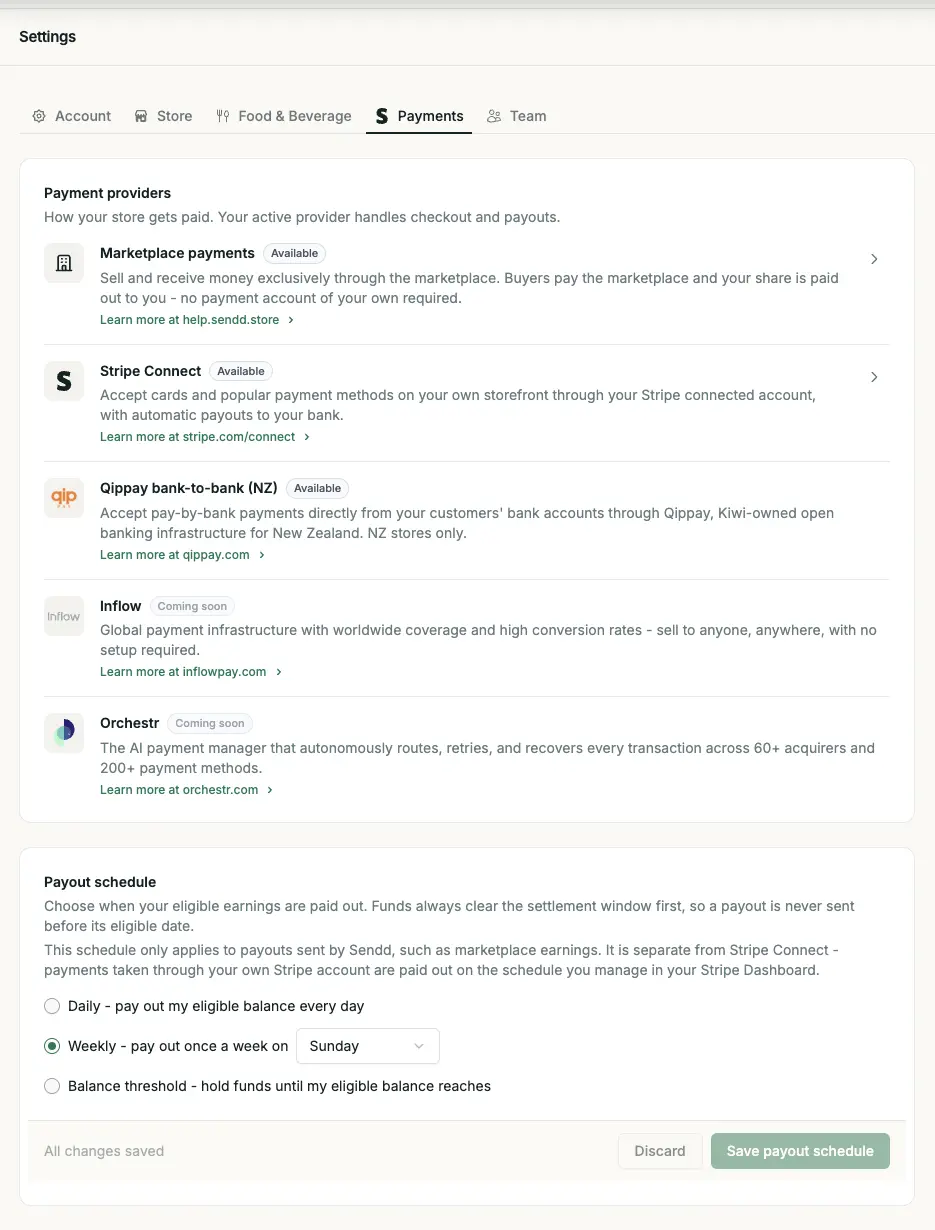
Inside a Sendd store’s payment settings: Stripe Connect and Qippay bank-to-bank (NZ) side by side, both available. The merchant controls their own payout schedule — a contrast to platforms where the platform decides when you get paid.
FAQ
Can I use my own Stripe account on Shopify? Yes, but it costs extra. Shopify charges a 0.5%–2% surcharge per transaction (depending on your plan) for using any payment gateway other than Shopify Payments. On $1 million in annual sales on the Basic plan, that’s roughly $20,000/year in surcharges alone, on top of Stripe’s own processing fees.
What happens to my payments if I leave Shopify? If you use Shopify Payments, your payment processing history is tied to Shopify’s system. You’ll need to set up a new processor on your next platform. If you used your own Stripe via Shopify (and paid the surcharge), your Stripe account comes with you, but you still lose any Shopify-specific payment data.
Is WooCommerce better than Shopify for payment control? WooCommerce with the separate Stripe plugin gives you full processor ownership with no surcharge, which is the cleanest option among incumbents. The trade-off is that WooCommerce is self-hosted: you manage your own server, SSL, security, updates and plugin compatibility. Realistic all-in hosting and extension costs run $90–105/month.
Can Sendd freeze my funds or hold my payouts? No. Sendd never holds your funds. Money goes from your customer directly to your own Stripe account (or your bank account on bank-transfer orders in NZ). Sendd charges the 1% platform fee separately. Stripe can still place holds on its own risk basis, but Sendd cannot.
What is a Merchant of Record? A Merchant of Record (MoR) is a company that becomes the legal seller in a transaction. Gumroad, Lemon Squeezy, Paddle and FastSpring are MoRs. They process the payment, handle tax remittance and absorb chargebacks. The trade-off: they take a larger cut (often 10%+), and the customer’s receipt shows the MoR’s name instead of your brand.
Why did BigCommerce add transaction fees in 2026? BigCommerce introduced its Open Payment Provider Fee on June 1, 2026, charging 0.6%–2% of GMV for using a processor not on its approved “Embedded” list. For years, “no transaction fees” was BigCommerce’s primary competitive differentiator against Shopify. That advantage no longer exists.
Does owning my own Stripe mean I never get funds held? No. Stripe conducts its own risk reviews and can place holds, reserves or close accounts independently. What own-Stripe eliminates is the second, platform-controlled layer of withholding. On Shopify Payments, both Shopify and its underlying processor can hold your money. On Sendd, only Stripe can, and you have a direct relationship with them to resolve it.
What’s the cheapest way to own my payment processor? Sendd: $0/month + 1% per sale + your own Stripe rates. No surcharge for using your own processor because it’s the default. WooCommerce with Stripe plugin: $0 software + ~$90–105/month hosting and extensions. Ko-fi Gold: $12/month + 0% fees. All three let you own your Stripe account with no penalties.
The bottom line
The platform you sell on should not be the platform that controls your money. When a platform owns your payment processor, it also owns the ability to freeze your funds, delay your payouts and charge you a penalty for wanting independence. The documented cases are real, ongoing and growing.
Sendd is payment agnostic. You connect your own Stripe account, you accept bank-to-bank payments where available, and Sendd never touches your funds. Your money is yours. Your data is yours. Your payment relationships are yours. If you leave, everything comes with you.
Start a free Sendd store in 60 seconds. Own your payments from day one.
By Maria Moreno, Growth at Sendd.
All claims link to their primary source. Platform policies and pricing were verified against official pages, July 2026. Fund-hold cases are sourced from named merchant accounts on public forums and news outlets. Subject to change. Re-verify before acting on these figures.
