
Sendd charges 1% per sale. Gumroad charges 10% plus 50¢ per direct sale, and 30% when buyers find you through its Discover marketplace, with card processing on top of the direct rate. On a $50 product sold directly, Gumroad’s platform fee is $5.50 and Sendd’s is 50¢. Gumroad’s genuine advantage is that it acts as Merchant of Record and handles global sales tax for you. If that tax handling is worth 9% of your revenue, stay. For most sellers it is not.
Key takeaways
- Gumroad charges 10% + 50¢ on direct sales plus separate card processing, and a flat 30% on Discover marketplace sales.
- Sendd charges 1% per sale with no subscription. Payment processing is separate through your own Stripe account, or flat 30¢ bank transfer in NZ.
- Gumroad is Merchant of Record and remits VAT, GST and sales tax worldwide on your behalf. On Sendd, tax compliance is yours to manage.
- Sendd sells every format from one store: digital, physical, subscriptions, event tickets, services and rentals. Gumroad is built for digital products and memberships.
- Sendd has native email marketing and segmentation with free monthly credits covering 500 contacts (then half or less of Klaviyo’s price, unlimited sends), plus Rocky, an AI assistant that works over your customer data.
Contents: How much does Gumroad charge? · What the fee difference looks like in practice · What you can sell on each platform · What Sendd includes that Gumroad does not · When to stay on Gumroad · How to move from Gumroad to Sendd · FAQ
How much does Gumroad charge per sale?
Gumroad takes 10% plus 50¢ on every direct sale, with card processing charged separately at about 2.9% + 30¢, which puts the real cost of a typical card sale near 12.9% plus 80¢ (Checkout Page, verified June 2026 ). Sales that arrive through Gumroad Discover are charged a flat 30% with processing included.
| Sendd | Gumroad (direct) | Gumroad (Discover) | |
|---|---|---|---|
| Monthly subscription | $0 | $0 | $0 |
| Platform fee per sale | 1% | 10% + 50¢ | 30% flat |
| Card processing | Your own Stripe rate | ~2.9% + 30¢, separate | Included |
| Bank transfer at checkout (NZ) | Flat 30¢ | Not offered as a standard checkout option | Not offered |
| Tax handling | Merchant manages own tax | Merchant of Record, tax handled | Merchant of Record |
| Payout threshold | Standard Stripe payouts | $100 minimum, 7 day hold | $100 minimum |
Figures checked 10 August 2026 against Gumroad’s published pricing.
Two Gumroad advantages deserve a straight acknowledgement. First, Merchant of Record status is real work you do not have to do: Gumroad calculates, collects and remits sales tax, VAT and GST worldwide. For a solo creator selling internationally with no accountant, that has genuine value. Second, Discover can bring you buyers you did not earn yourself, and paying 30% for a customer you would never have found can be rational.
The counterweights are also real. In March 2026 Gumroad raised its minimum payout threshold from $10 to $100 (CheckThat, 2026 ), so a creator earning $25 a month now waits four months for a first payout. And the fee never scales down: 10% of your thousandth sale is the same as 10% of your first.
What does the fee gap look like in real money?
On $2,000 a month in direct sales at a $50 average price, Gumroad’s platform fee alone is $220. Sendd’s is $20.
| Monthly sales ($50 avg) | Sendd platform fee | Gumroad platform fee (direct) | Annual difference |
|---|---|---|---|
| $500 | $5 | $55 | $600 |
| $2,000 | $20 | $220 | $2,400 |
| $5,000 | $50 | $550 | $6,000 |
| $10,000 | $100 | $1,100 | $12,000 |
Platform fees only. Card processing applies on both platforms and is broadly similar through Stripe. Figures checked 10 August 2026.
At $5,000 a month, the difference funds a serious ad budget. At $10,000 a month, one analysis puts Gumroad’s total annual take above the cost of a full-time virtual assistant (ChargePanda, 2026 ). A percentage model means your costs scale exactly as fast as your success, so the question is whether the percentage buys enough. Run your own numbers in the Sendd fee calculator .
What can you sell on Sendd that you cannot sell on Gumroad?
Sendd sells every format from one store: physical products, digital downloads, subscriptions, event tickets, services, bookings and rentals. Gumroad is built for digital products, memberships and limited service products, with categories like calls and commissions restricted to eligible accounts under its service rules.
For a creator this matters the day your business grows sideways. Sell a course today, and tomorrow you want to sell a workshop ticket, a paid community, a physical workbook or a 1:1 session. On Gumroad some of that is possible and some is not. On Sendd it is all the same store, one catalogue and one customer list.
What does Sendd include that Gumroad does not?
Sendd has native email marketing, customer segmentation and Rocky, an AI assistant that operates over your commerce and customer data. Free monthly credits cover your first 500 contacts; beyond that, pricing runs at half or less of Klaviyo’s with unlimited sends, because Sendd charges per contact and passes the underlying sending cost on rather than metering your emails.
Rocky is the practical difference. You can ask it in plain language to find everyone who viewed a specific product, bought something in the last six months and attended your launch event, then email that segment an offer. That query crosses product views, purchase history, a time window, event attendance and a marketing action in one sentence. Gumroad has audience emailing built in, but not natural-language segmentation across behaviour and events.
Sendd MCP is also live in Claude’s connector directory, so an AI assistant can operate your store directly: check sales, update products and analyse customers through conversation.
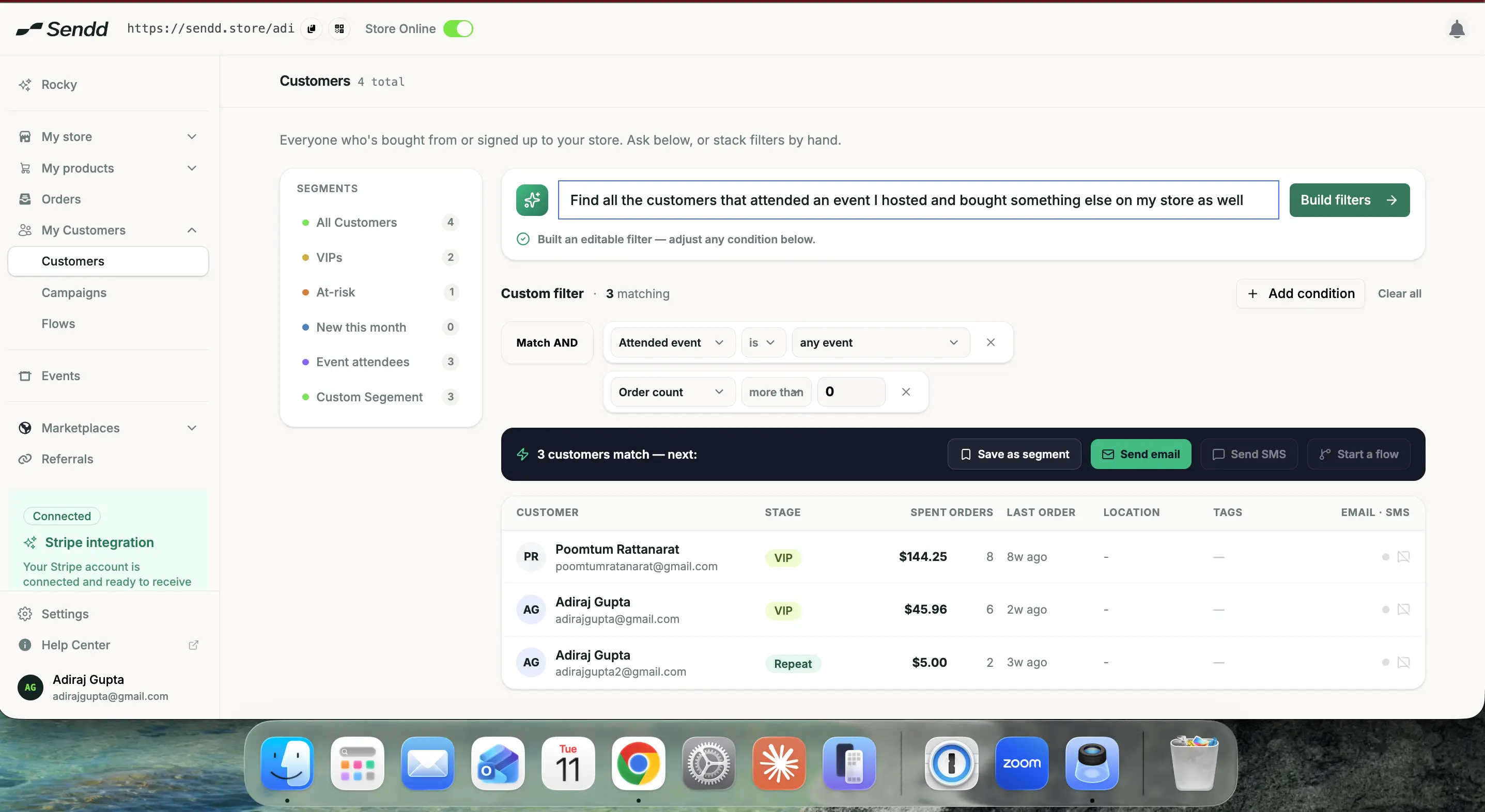 Rocky building a customer segment from a natural language query.
When should you stay on Gumroad?
Stay on Gumroad if international tax compliance is your biggest headache, if Discover genuinely drives a meaningful share of your sales, or if you want the absolute minimum setup for testing a product idea.
Choose Sendd if you sell more than occasionally, want to keep 99% instead of 90%, plan to sell beyond digital products, or want native email, segmentation and AI in the same platform.
Choose Gumroad if you want Merchant of Record tax handling bundled into the fee, rely on Discover for buyers, or are validating a first product with zero setup.
How do you move from Gumroad to Sendd?
Switching takes an afternoon for a typical catalogue: export your Gumroad data, import products into Sendd, connect Stripe and redirect your links.
- Export your data. Customer emails and sales history export from Gumroad as CSV. Download your product files and covers.
- Rebuild your catalogue on Sendd. Same names, descriptions and pricing so returning buyers recognise you.
- Connect Stripe. Your own account, your own payouts, no $100 threshold or 7 day hold beyond Stripe’s standard schedule.
- Redirect your links. Update the product links in your bio, posts and email footer. If you used a custom domain, point it at your Sendd store.
- Tell your list. You now own the email relationship. Announce the new store with an offer and watch the first segment Rocky builds for you.
Note the tax change honestly: leaving a Merchant of Record means sales tax registration and remittance become your responsibility where thresholds apply. For many sellers, especially NZ-based sellers under GST registration thresholds or already GST-registered, this is routine accounting. If your international footprint is complex, ask your accountant before switching.
FAQ
Is Sendd cheaper than Gumroad? Yes, by roughly 9 percentage points per direct sale. Sendd charges 1% per sale against Gumroad’s 10% + 50¢, with card processing separate on both. On $5,000 of monthly direct sales that is about $500 a month difference in platform fees. Gumroad bundles global tax handling into its fee, which Sendd does not.
Does Gumroad handle sales tax and VAT? Yes. Gumroad is the Merchant of Record on every transaction and calculates, collects and remits sales tax, VAT and GST worldwide. This is Gumroad’s strongest genuine advantage. On Sendd you sell through your own Stripe account, so tax compliance is your responsibility, as it is on most ecommerce platforms.
What is the Gumroad Discover fee? Gumroad charges a flat 30% including processing when a buyer finds your product through its Discover marketplace, against 10% + 50¢ plus processing for direct sales. Sellers report limited control over which sales get tagged as Discover.
Can I sell physical products on Sendd? Yes. Sendd supports physical products, digital downloads, subscriptions, event tickets, services and rentals from one store, with a 1% fee on all of them. Gumroad is designed primarily for digital products and memberships.
Does Sendd have a payout minimum? No platform minimum. You are paid through your own Stripe account on Stripe’s standard payout schedule. Gumroad has a $100 minimum payout threshold and a 7 day holding period on sales.
Can AI help run a Sendd store? Yes. Rocky, Sendd’s AI assistant, analyses customers and builds marketing segments from natural language, and Sendd MCP is live in Claude’s connector directory so an AI assistant can operate the store directly.
The bottom line
Gumroad charges 10x Sendd’s platform fee and buys you tax handling and a marketplace with it. If those two things are not carrying your business, you are overpaying for them on every sale. Move the catalogue, keep 99% and put the difference into finding customers.
Start selling for 1% with no subscription → Create your free Sendd store or try the fee calculator .
By Adiraj Gupta, founder of Sendd.
Competitor pricing checked against live pricing pages, 10 August 2026. Figures are illustrative and should be re-verified before acting on them.
