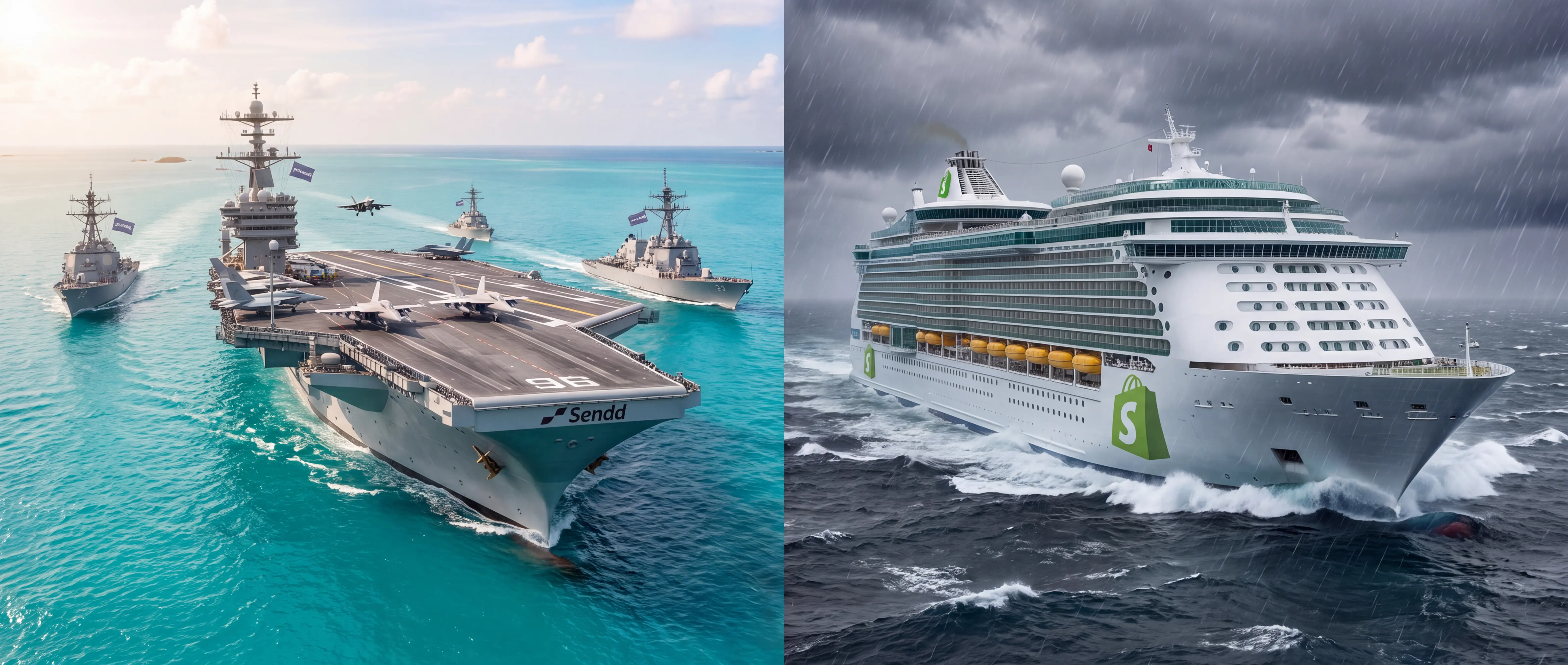
Almost every commerce platform of the last 30 years is built like a cruise ship: one hull, one type of passenger, one shipping lane and a price for everything that isn’t the buffet. Sendd is built like a carrier strike group: a fleet of purpose-built product engines that share one hull-to-hull intelligence layer, move as one unit and turn on a dime. A cruise ship cannot become a carrier fleet. That is the whole thesis. Everything below is the argument.
Key takeaways
- Vertical SaaS platforms are built for one customer type. Everyone else is a bad fit paying full price.
- The average Shopify merchant runs six or more paid apps just to make the platform do their job, and the plan fee is the smallest line on the bill.
- SaaS prices are rising at roughly five times the rate of general inflation because switching is painful, not because the software got five times better.
- The biggest companies on earth (Google, Microsoft, Meta, Amazon) are carrier fleets in disguise: purpose-built products sharing one intelligence layer. Commerce is one of the last major categories still run by cruise ships.
- Sendd treats physical products, digital products, services, rentals, tickets and custom pricing as native primitives, not apps, on one platform at 1% per transaction with no subscription, already used by 200+ businesses from hotels to musicians.
- Sendd shares the fee instead of stacking fees: merchants can split up to 30% of Sendd’s 1% across the third-party apps they deploy, at no extra cost, and referrers earn 20% of Sendd’s revenue from referred customers for five years.
- Shopify penalises using your own payment processor with an extra 0.6% to 2% fee per sale. Sendd charges 1% no matter whose processing rate you’ve negotiated.
- Unlike ad-funded fleets that make money per user and per business, Sendd makes money exactly one way: 1% when a business makes a sale. If the merchant earns nothing, Sendd earns nothing.
- When one platform-wide capability ships (email, analytics, AI), every product type gets it on day one. That compounding is structurally impossible to retrofit onto a single-lane platform.
I’ve been meaning to write this article for a while. It’s my brain dump on how and why Sendd wins the arms race we’re in, and a window into how we think and operate as a company. It starts with a question about boats.
Why is every software platform built like a cruise ship?
For the last 20 to 30 years the playbook for building a software company has been the same: pick a vertical, pick a customer, solve one problem for that one customer, then monetise the edges. Sell the base package (the non-balcony cabin) and charge for upgrades. It’s a proven model. It’s also a cruise ship: enormous, comfortable in its own shipping lane, brilliant at exactly one journey and almost incapable of doing anything else. Cruise ships don’t manoeuvre. They follow the itinerary.
The clearest example is Shopify, and I want to be fair about this before I go hard on it: Shopify is a genuinely great cruise ship. If you sell physical products direct to consumer, it is polished, reliable and battle-tested, and if you use Shopify Payments there are no extra platform transaction fees on top of card processing. For its core passenger, the ship works.
The problem is everyone who isn’t that passenger.
Try selling a digital product on Shopify and you’re immediately in a grey area. Even Shopify’s own answer to digital downloads is an app you bolt on, not something the platform natively understands. Try selling a service and it gets stranger: a service on Shopify is essentially a physical product where you didn’t tick the “this is a physical product” box. No shipping, no inventory, no booking logic. It technically exists, but the platform doesn’t actually know what it’s selling. Bookings, rentals, memberships, custom pricing: none of these are native primitives. They’re workarounds stacked on primitives designed for boxes on shelves.
So what happens? The merchant does what everyone on a cruise ship does: they pay for the excursions. Over 80% of Shopify merchants use third-party apps, and the average merchant runs at least six . Merchants doing between $2K and $70K a month typically run about ten . The average paid Shopify app costs roughly $67 a month across its plans . That’s before the plan itself, which in 2026 runs $39 a month for Basic, $105 for Grow and $399 for Advanced, with Plus starting at $2,300 a month on a three-year term . One analysis put it plainly: looking at the plan price alone significantly underestimates your actual costs, with apps and add-on tools adding $50 to $200 a month for typical stores .
Even the money itself travels a tolled lane. Shopify’s “0% transaction fees” only applies if you use Shopify Payments. Bring your own payment processor, even one you’ve negotiated a better rate with, and Shopify adds a penalty fee of 0.6% to 2% on every sale on top of whatever your processor charges. That’s not a fee for a service. That’s a fee for declining a service, and it exists purely to make leaving the ship’s casino more expensive than staying.
It’s like buying a car where the headlights, the brakes and the indicators are each a separate monthly subscription, sold to you by a different company, held together with duct tape and a prayer. The thousands of apps in these ecosystems aren’t a sign of platform strength. They’re a map of everything the platform can’t natively do.
What does the cruise ship model actually cost merchants?
Here’s where it stops being an inconvenience and starts being a tax.
Because each vertical cruise ship serves exactly one customer type, a business that spans two categories (a potter who sells ceramics, workshop tickets and a wheel-throwing course; a gym that sells memberships, apparel and casual sessions) has to charter between ships. Two platforms. Two checkouts. Two customer databases. Two subscriptions. Getting them to talk to each other is a private charter between two cruise ships in open sea: expensive, slow and a headache someone has to organise every single month.
And because leaving is painful, the ships have become very comfortable raising prices. As of January 2025, SaaS pricing was up 11.4% year on year against a 2.7% average market inflation rate across G7 countries , and it accelerated from there: by March 2026 the SaaS inflation rate hit 13.2%, nearly two points higher than a year earlier . SaaS inflation is now running at nearly five times the standard market inflation rate of G7 countries . Gartner’s software negotiation practice reports subscription costs from several large vendors rose 10% to 20% in a single year, against IT budget growth of just 2.8% . This is not value keeping up with inflation. This is pricing power extracted from customers who can’t easily leave, and 61% of organisations surveyed by Zylo cut projects in the past 12 months because of unplanned SaaS cost increases .
The deepest cost isn’t even the money. It’s operational. When your commerce stack is six to ten apps duct-taped across one or two platforms, your data is fragmented across all of them. Your analytics don’t agree with each other. Your customer exists as five different records in five different tools. You need custom plumbing to answer basic questions like “who are my best customers?” and the plumbing breaks constantly. Merchants end up spending their operating hours firefighting integrations instead of running the business. They never get the operational leverage to execute at the scale they’re actually capable of.
And the breakage isn’t bad luck. It’s structural. When anything changes on the ship itself, an API update, a checkout revision, a theme change, every strip of duct tape holding your stack together needs re-taping at once, because none of those apps were ever truly part of the ship. When Shopify deprecated its old checkout customisation layer, merchants and developers across the entire ecosystem had to rebuild work they’d already paid for, on Shopify’s timeline, just to stand still. That’s the duct tape economy in one sentence: you don’t own a system, you own a truce between ten systems, and the truce gets renegotiated every time any one of them moves.
That’s the cruise ship economy: sign up, spend a few hundred dollars a month, discover you’re the wrong passenger, churn out. And a fleet of new vertical cruise ships gets built for each abandoned customer type, each one repeating the same model in a narrower lane.
Who are the biggest carrier fleets in the world?
Here’s the thing nobody says out loud: the biggest businesses on earth are carrier fleets in disguise, and they’ve been proving this model for decades.
Google looks like a search engine. It’s a fleet. Search is the carrier, and YouTube, Maps, Android, Gmail, Chrome and Cloud are each purpose-built vessels, all sharing one identity layer, one data layer and one ad engine that gets stronger every time any vessel engages. Microsoft is a fleet: Windows, Office, Azure, LinkedIn, GitHub and Teams, welded together by a single identity graph, so when Copilot launched it wasn’t one product getting AI, it was the entire formation gaining a capability at once. Meta runs three of the largest social platforms in history off one shared advertising intelligence layer. Amazon pairs a marketplace with logistics, Prime and AWS. Different vessels, one fleet doctrine.
None of these companies win because any single product is unbeatable. Plenty of standalone products have been better than theirs at various points. They win because capability compounds across the formation. When Microsoft launched Teams it wasn’t a startup fighting for distribution, it was a new vessel launched under the fleet’s full radar coverage, bundled to hundreds of millions of existing seats. Zoom, a genuinely brilliant single-purpose cruise ship, had to fight that with a better product and a marketing budget. Formation beats vessel, almost every time.
And look at what’s happening to the cruise ships right now. Single-lane software is being disrupted as we speak, from both directions at once: fleets bundle their feature into an existing formation, and AI makes rebuilding their one capability a weekend project instead of a moat. The pattern across 30 years of software is remarkably consistent. Fleets absorb. Cruise ships get absorbed.
Commerce is one of the last major categories still dominated by cruise ships. That’s not an observation we’re making from the shore. That’s the opening we’re sailing through.
But hold onto one question about those giant fleets, because I’m coming back to it at the end: whose side are they actually on?
What is a carrier strike group platform?
Sendd is built completely differently, and the metaphor we use internally is a carrier strike group.
A carrier strike group is not one big ship. It’s a fleet of vessels, each custom-built for a specific job, that operate as a single coordinated unit. In Sendd’s fleet, physical products are the aircraft carrier: the centrepiece, full inventory, shipping and fulfilment capability. Digital products are the submarine: silent, instant, delivered without a single box moving. Custom pricing is the battleship: heavy, flexible firepower for quotes, pay-what-you-want and negotiated work. Rentals and bookings are the destroyer: fast, precise, time-aware. Tickets, subscriptions, services: each one a purpose-built vessel, not a physical product with the box unticked.
Here’s the definitional sentence, because it matters: Sendd is a commerce platform where every product type is a native primitive sharing one checkout, one customer record, one analytics layer and one intelligence layer, at 1% per transaction with no subscription. Payment processing stays separate, transparent and yours. You bring your own processing relationship through your own Stripe account, and in New Zealand we make bank-to-bank transfer a real checkout option at a flat 30 cents, a rail most platforms don’t offer at checkout at all. Crucially, we never penalise your choice of rails. If you’ve negotiated a 1.5% processing rate, your all-in cost on Sendd is 2.5%: your rate plus our 1%, full stop. Run that same negotiated rate through Shopify and you’re paying your processor, plus their 0.6% to 2% penalty for not using Shopify Payments, plus the monthly plan, plus the app stack. On payment terms alone, before anything else in this essay, the fleet is cheaper than the cruise ship. Your negotiating leverage stays yours, because on a fleet built for the business, a better deal you win is a better deal you keep.
The fleet structure is what makes capability compound. When we add native email and abandoned cart recovery, that’s missile capability added to every ship in the fleet at once: the potter’s workshop tickets get it the same day the apparel brand’s t-shirts do. When we add analytics, that’s satellite and radar coverage across every touchpoint, not another dashboard that disagrees with your other four dashboards. When we launched Rocky, our built-in AI store assistant, every merchant on the platform woke up with a co-pilot that could pull sales reports, monitor inventory and track customer patterns across every product type they sell, on day one, at no extra cost. When we harden security or ship a checkout improvement, the entire fleet gets more capable simultaneously. No app to install. No integration to babysit. No second subscription.
And the modularity works in both directions. Real fleets rotate vessels in and out of formation without the formation ever losing capability, and Sendd is built the same way. We can upgrade a vessel, refit an engine or launch an entirely new ship class and nothing else breaks, because every vessel speaks the same native command language instead of being lashed to the hull with duct tape. Change on a cruise ship is a demolition that everyone aboard pays for. Change in a fleet is a refit: the upgraded vessel rejoins the formation and the entire network simply gets more powerful. Merchants never rebuild anything to stand still. They just wake up with more capability than they had yesterday.
One flagship carries the fleet’s radar so every vessel doesn’t need its own; one platform carries the intelligence layer so every product type doesn’t need its own analytics app. That’s the difference between a fleet and a flotilla of strangers.
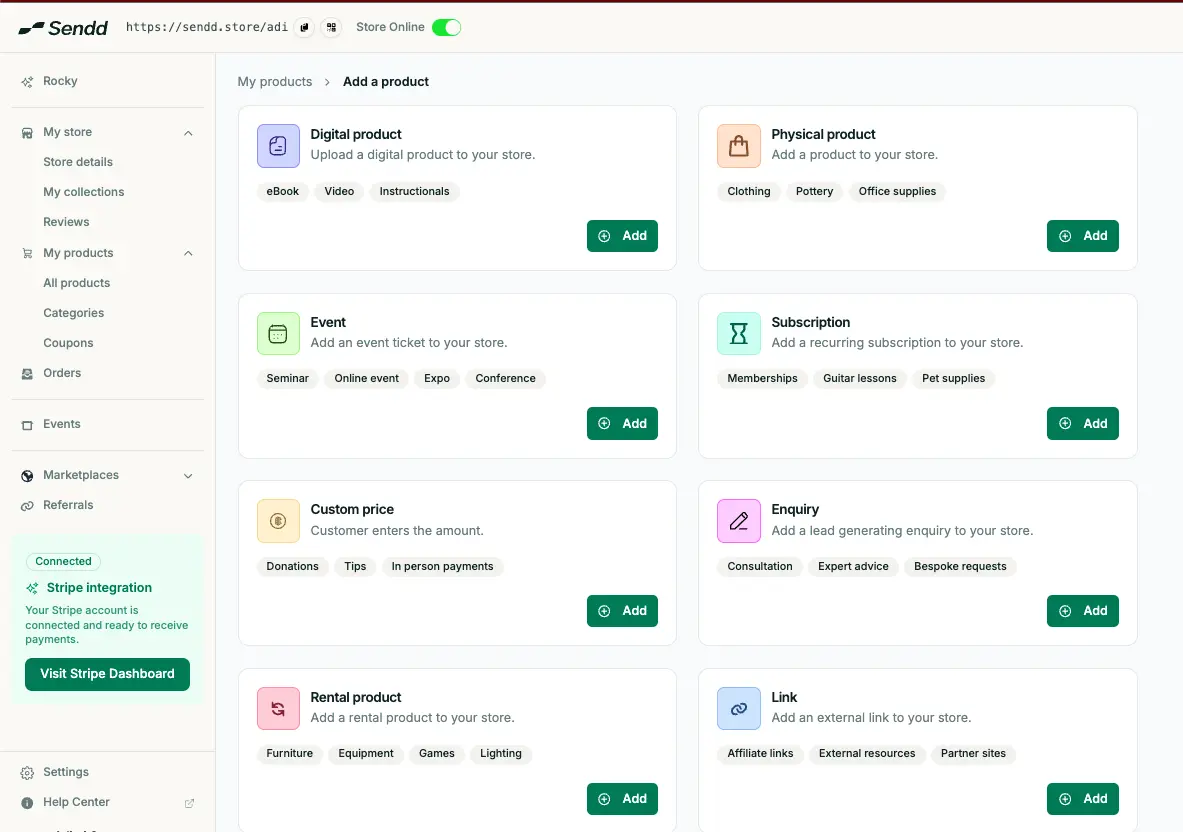
The fleet, exactly as merchants see it: every vessel is just an Add button.
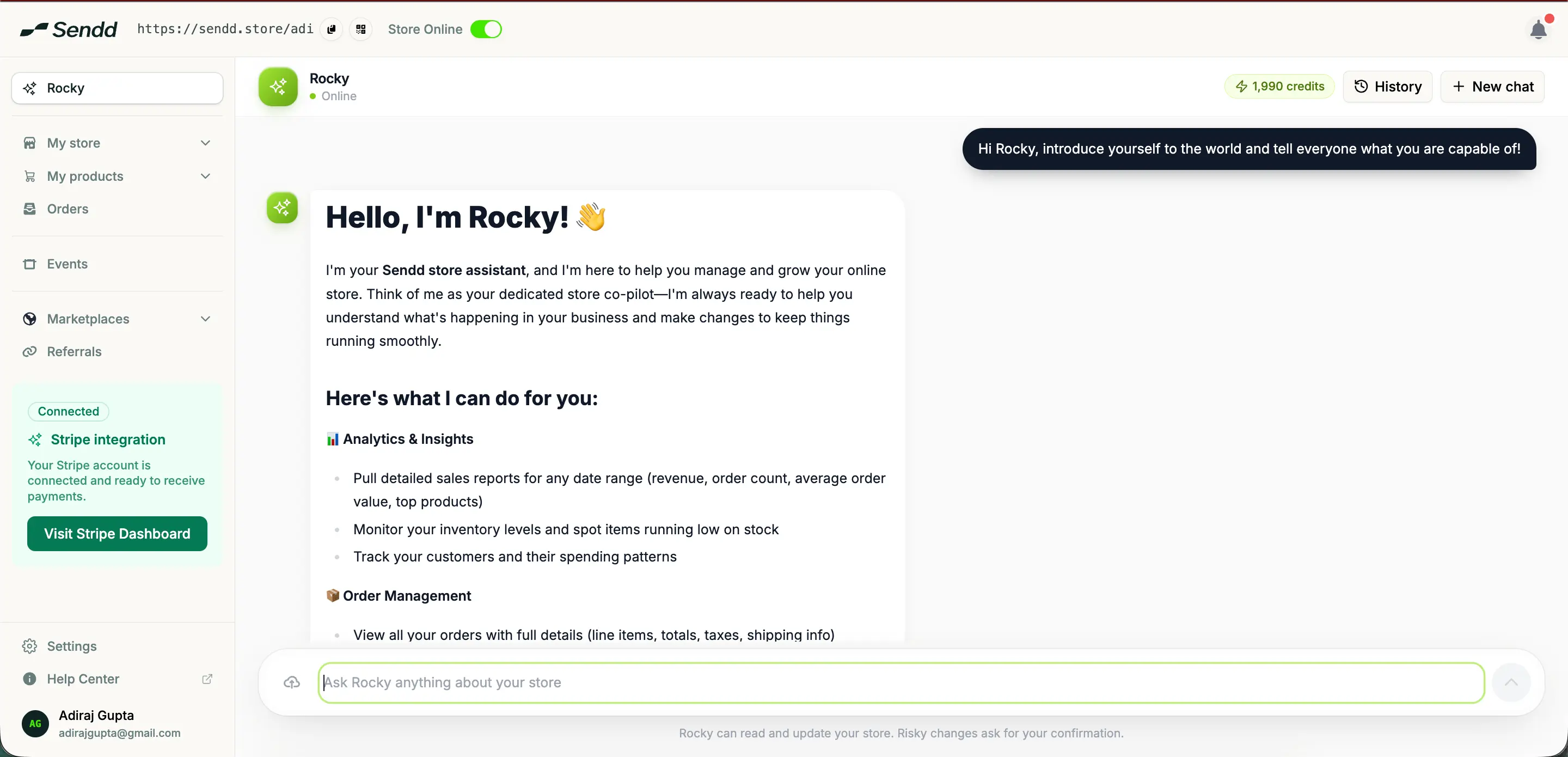
Rocky, the fleet’s intelligence layer: analytics, insights and store management, native to every product type.
What does a fleet look like in the wild?
Let me make this concrete, because doctrine is cheap and customers are not.
Not long ago, a motel owner selling physical products through their Sendd store told us they loved the experience and asked a question that changed our roadmap: could Sendd handle accommodation? We met them, mapped the systems they were juggling and then validated the same thesis with a larger hotel chain, who loved it even more. So accommodation is the next vessel joining the fleet, and look at what a hotel becomes the day it launches. Rooms sold through their own store and through Sendd marketplaces. Events run natively. Function spaces hired out as rentals. Food and beverage ordered straight from the restaurant. Retail sold from the lobby. City guides and local to-do lists delivered as digital products. Massages booked as services at the spa. One complex, multi-format business brought into a single native experience, with bundling across all of it, one place to run everything from, synced with their OTAs and property management system so there’s never a double booking. Count the vessels in that formation. On the cruise ship model that’s six or seven separate subscriptions and a part-time job gluing them together. On Sendd it’s one login and 1%. And notice how the vessel got commissioned in the first place: not from a strategy deck, but from a real merchant asking for it.
The same turning point hit for musicians and authors: sell books, music and merch physically or digitally, run your own gigs and signings as events, take commission work through enquiries, get paid for service jobs, all from one store. These are businesses that never had a platform actually built for their shape, because their shape was never one vertical.
And here’s the part that should worry the incumbents most: the fleet doesn’t just win the businesses the cruise ships ignored. It outguns them in their own home waters. Take a pure physical products seller in New Zealand, the exact customer Shopify was built for. On Shopify, the moment they want serious email marketing they’re paying for Klaviyo on top of everything else, and the moment they want real-time rates from a shipping aggregator like GoSweetSpot they discover carrier-calculated shipping is gated behind the upper plans, at $399 to $2,300+ a month . On Sendd, email marketing with proper segmentation and automated workflows is native, with a large free tier and then cost-plus pricing that works out at roughly a quarter of what dedicated email tools charge, and GoSweetSpot shipping is natively integrated at no platform cost. Physical products are meant to be Shopify’s aircraft carrier. We put more firepower on that deck too, for 1%.
None of this is hypothetical. The motel, the hotel chain, the musicians and the authors are all real customers and real conversations from the 200+ businesses running on Sendd and counting. And every vertical we add follows the pattern that motel started: a real business asks, we build the vessel properly, the whole fleet gets stronger and the next industry aboard inherits everything that came before it on day one. As YC has drilled into founders for two decades, we’re just making something people want, vertical by vertical, and letting the compounding do the rest.
Why is the Sendd App Store more powerful than a cruise ship’s?
A fair reader will now ask: you just spent half this essay attacking app ecosystems, and you’re opening one? Yes. And the difference between the two is the whole point.
Cruise ship apps patch holes in the hull. They exist because the core is incomplete, and every serious capability you bolt on is fighting the ship’s own design. Mount a cannon on a cruise deck and the first time you fire it, the recoil rips the ship apart. That’s why heavily app-stacked stores end up slow, fragile and fragmented: the hull was never engineered for the hardware.
The Sendd App Store is the opposite architecture. Sendd’s core is already complete, so apps don’t patch, they extend. And because the platform was designed from day one to link outward through MCP and native APIs, a third-party app doesn’t strap onto the hull. It joins the formation as a new vessel: shared identity, shared data model, shared intelligence layer, full radar coverage from the moment it connects. Adding capability strengthens the fleet instead of straining it. That’s how an ecosystem built on a complete platform ends up more powerful than one built on an incomplete platform, even a vastly bigger one.
Then there’s the economics, and this is where our fleet doctrine gets literal: carrier fleets share and care for each other. So we built sharing into the money flows.
- Apps share our fee, not stack on top of it. When a merchant deploys third-party apps to their store or market, up to 30% of Sendd’s 1% transaction fee is shared with those apps, and the merchant chooses how to split it across them. Zero additional cost to the merchant, however many apps they run. On a cruise ship, six apps means six separate bills. On Sendd, developers get paid out of our cut, allocated by the merchants who actually find them valuable, which means every developer in the ecosystem is financially aligned with merchant success rather than merchant lock-in.
- Referrers earn for five years. Anyone who refers a customer to Sendd earns 20% of the revenue we make from that customer, for five years. Bring a ship to the fleet and you share in what the fleet wins.
- Distribution is a native capability, not another lane to charter. Through Sendd Market , merchants plug into curated marketplaces for visibility and sales channels as part of the platform itself. On a cruise ship, reaching new customers means buying passage in someone else’s shipping lane. In a fleet, distribution is what the formation does.
Compare the incentive structures and the endgame is obvious. A cruise ship’s ecosystem depends on the core staying incomplete: thousands of developers billing merchants for functionality the platform declines to build. Our ecosystem depends on the core being strong: developers earn more when merchants sell more, referrers earn when the fleet grows and nobody’s business model requires the platform to stay broken.
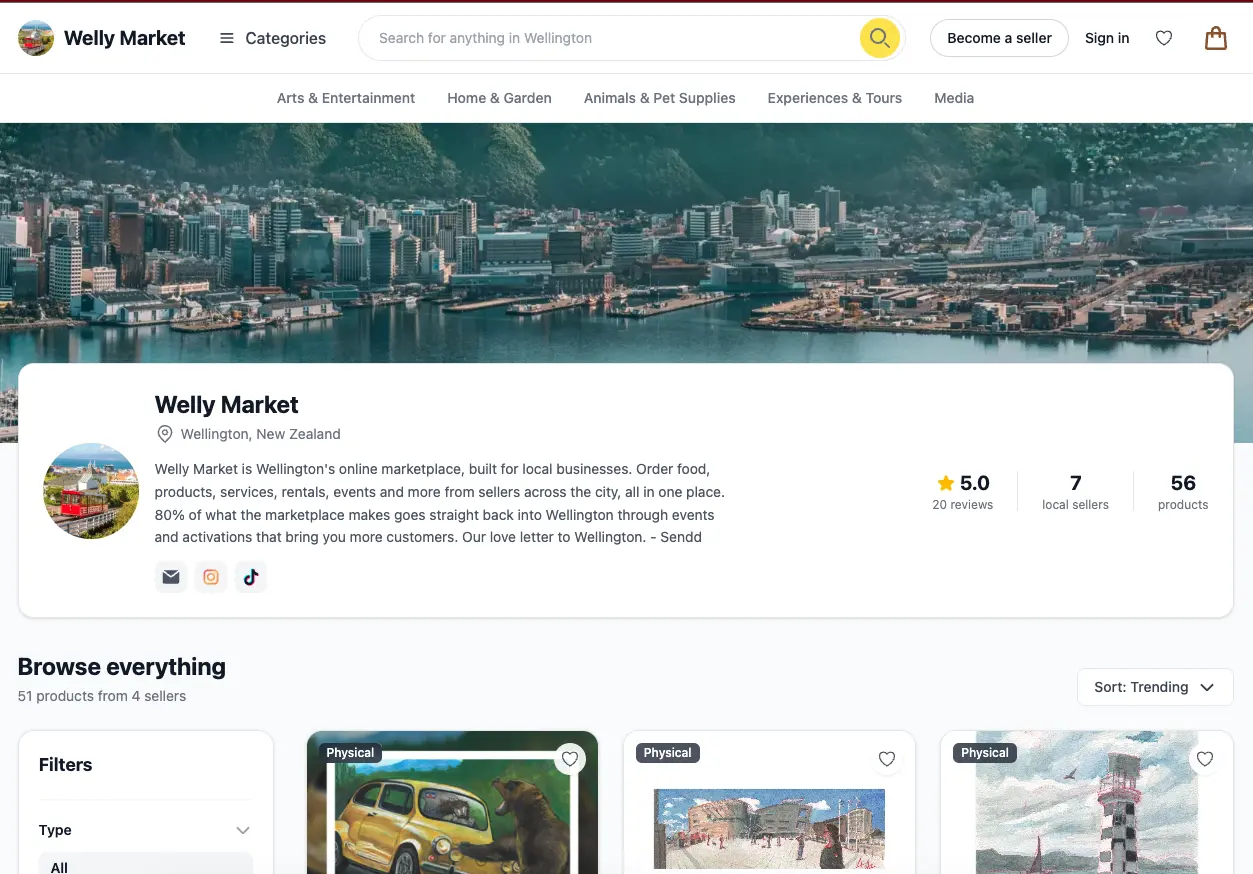
Welly Market, Wellington’s marketplace on Sendd: 80% of what the marketplace makes goes straight back into Wellington. Our love letter to the city.
Doesn’t horizontal mean shallow?
The sharpest objection to everything above is an old one: platforms that do everything do nothing well. Jack of all trades, master of none. Vertical tools win because they go deep.
Except the retort I prefer completes the saying: “A jack of all trades is a master of none, but oftentimes better than a master of one.” The half everyone quotes is a warning. The whole thing is a strategy.
Still, the warning is fair, and it’s exactly why we didn’t build one big ship. Shallowness doesn’t come from breadth. It comes from forcing every kind of product through primitives designed for a different one, which is precisely what happens when a physical-products hull stretches to cover services by leaving the shipping box unticked. That’s a generalist ship, and generalist ships deserve the criticism.
A fleet is the opposite answer. Each vessel is purpose-built, which is vertical depth. A booking on Sendd natively understands time, availability and calendars. A digital product natively understands delivery, access and download rules. A rental natively understands return dates and deposits. A custom-priced job natively understands quotes and negotiation. Each product type gets the depth of a dedicated vertical tool, and then the formation gives them what no vertical tool can: one checkout, one customer record, one intelligence layer across all of it. Vertical at the vessel, horizontal at the fleet. We’re not a generalist ship, and we’re not a master of one. We’re a fleet of masters.
How do the two models actually compare?
| Vertical cruise ship (e.g. Shopify) | Sendd carrier fleet | |
|---|---|---|
| Monthly platform fee | $39 to $399 (Plus from $2,300) | $0 |
| Platform fee per sale | 0% with Shopify Payments; 0.6% to 2% surcharge with external providers | 1% flat, any product type |
| Payment processing | Shopify Payments, or pay a 0.6% to 2% penalty to use your own | Your own processing relationship, never penalised (NZ: bank transfer at flat 30¢) |
| Digital products | Via app | Native |
| Services and bookings | Via apps or workarounds | Native |
| Rentals | Via apps | Native |
| Custom pricing / quotes | Via apps | Native |
| Email + abandoned cart | Via apps (average paid app ~$67/month ) | Native |
| Typical app stack | Six or more apps for the average merchant | None required |
| Third-party app cost to merchant | Each app bills separately | $0 extra: up to 30% of Sendd’s 1% shared across your apps |
| Ecosystem incentive | Developers bill merchants for missing features | Developers earn when merchants sell |
| Distribution | Your own traffic, your own ads | Native marketplaces via Sendd Market |
| Customer data | Fragmented across apps | One record, one layer |
Figures checked 7 August 2026 against live pricing pages and published platform statistics. Shopify’s 0% transaction fee with Shopify Payments is a real advantage for pure physical-product merchants at volume, and we’d rather say that plainly than pretend otherwise.
Why does a fleet beat a cruise ship in the AI era?
This is the part I think most people underestimate, and it’s why I call this an arms race rather than a market.
AI agents are becoming a real interface to commerce. Merchants are already asking assistants to run their stores, and buyers are starting to ask assistants what to buy and where. An AI can pilot a fleet with one unified command structure: one API surface, one data model, one source of truth about products, customers and orders. Sendd ships a native MCP server, which means an AI assistant can operate an entire Sendd store (every product type, every capability) through a single connection. Ask an agent to pilot a cruise ship plus ten duct-taped apps and it has to juggle ten permission systems, ten data formats and ten places where the truth about a single customer lives. Coordination cost isn’t just a merchant problem anymore. It’s an AI problem, and AI routes around it.
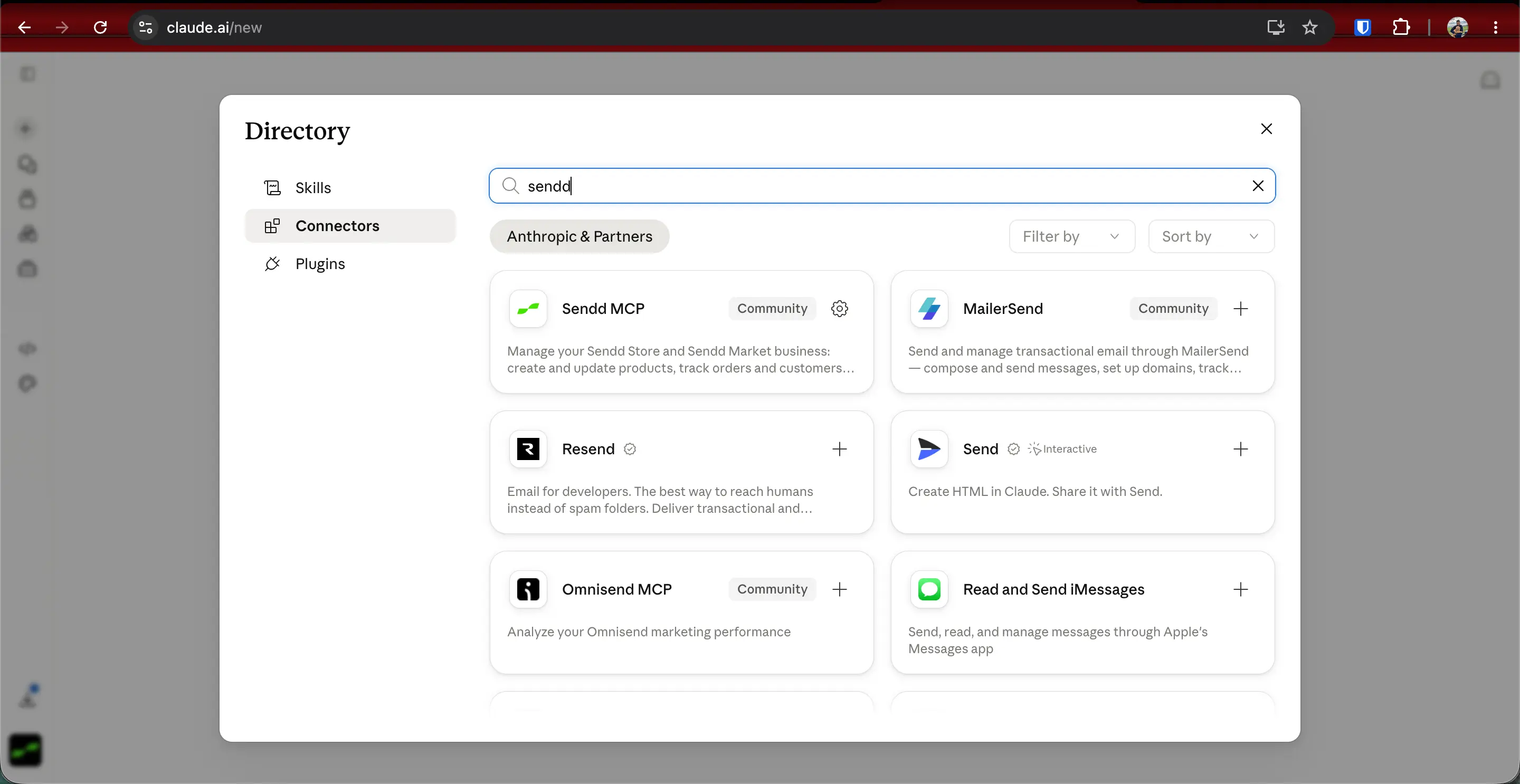
Not a roadmap slide. Sendd MCP, live in the Claude connector directory today.
Which brings me to the strategic endgame. For a cruise ship to turn itself into a carrier fleet is close to impossible. The hull is the hull: the data model, the pricing model, the app ecosystem with thousands of businesses financially dependent on the platform staying incomplete. Every one of those app developers is a constituency against making the platform natively whole. The incumbents’ greatest strength, the ecosystem, is a structural commitment to the duct tape.
But for a carrier fleet to show up out of the dark and win hearts and minds? That’s just execution. We don’t need to convert the cruise ship’s happiest passengers, though as the New Zealand physical seller shows, we’re armed for that fight too. We need to be there for everyone the shipping lane was never built for: the digital sellers, the service businesses, the renters, the ticket sellers, the multi-format businesses that currently charter between ships and pay the coordination tax. That’s not a niche. That’s most of commerce.
Whose side is the fleet on?
Now the question I asked you to hold onto, because it’s the part I’ve been building toward the whole essay.
Google and Meta are magnificent fleets. But look at how they make money and ask who the fleet actually fights for. Nearly all of their revenue is advertising: businesses pay to reach customers, auction dynamics push the price of attention relentlessly upward and a massive percentage of the value a small business creates gets captured before a single sale even happens. Businesses end up renting access to their own customers, and the rent goes up every year. And on the other side of the ledger, these fleets report their success as average revenue per user: every person aboard is worth a set number of dollars per quarter, and the machine exists to collect it. The user isn’t the customer. Neither, really, is the business. Both are the waters the fleet patrols, and passage through those waters is never free.
Sendd is built completely on the side of the business, and not because we’re nicer people. Because of structure. There’s no subscription, no ad auction, no per-seat toll, no per-user monetisation and no percentage of your marketing budget disappearing into an algorithm. We make money exactly one way: 1% when a business makes a sale. If a merchant makes nothing this month, we make nothing from them this month. Which means the only way Sendd grows is by making businesses more money: better conversion, better tools, better distribution, better intelligence. Every hour of engineering we do is pointed at exactly one outcome, growing merchant revenue, because our 1% grows with it and only with it. As far as I can tell, that makes us one of the only fleets on the water built to be fully, structurally on the side of the business.
You can see the difference in where the energy goes. Watch the subscription platforms and so much of their effort pours into marketing, win-back campaigns for churning customers and squeezing more revenue per merchant, because a subscription model forces you to fight customers who are leaving instead of fighting for customers to win. My honest read is that if the incumbents had spent the last decade optimising for customer outcomes with the intensity they spend optimising revenue, they’d all be far bigger companies today. We don’t run that treadmill and we don’t spend our days drafting justifications for price hikes, because our raise arrives automatically, at the same 1%, every time a merchant grows. Customer success isn’t our marketing strategy. It’s our entire revenue model.
And if you want proof that customer obsession wins, and a warning about what happens when it fades, Amazon is both in one company. For two decades it was the most customer-obsessed operator in commerce, relentlessly cutting prices and friction in exactly the space Shopify plays in, and the market’s verdict is unambiguous: Amazon is a two trillion dollar company against Shopify’s roughly $190 billion , more than ten Shopifys. Customer obsession, compounded across a fleet, is the most successful strategy in the history of commerce. But watch what happens when alignment lives in the culture instead of the structure. As the flywheel matured, the obsession drifted toward extraction: analysis of seller profit-and-loss statements shows Amazon now takes around 50% of a typical seller’s revenue once referral fees, fulfilment and effectively unavoidable advertising stack up, up from roughly 40% five years earlier. And as if that take rate weren’t enough, Amazon increasingly launches products that compete head-on with the very brands selling through its platform, turning its own customers into its competition. Twenty years spent earning trust as the most customer-aligned company on earth, now being spent down. That’s the lesson: cultures change when incentives allow it. Ours can’t drift, because ours isn’t a culture. The 1% is the alignment.
Their fleets charge you for safe passage through waters they control. Our fleet exists to get your cargo to port.
Strip away all the boats for a moment, because the thesis works in plain language too. Software spent 30 years being sold as narrow tools at wide margins. Sendd is one platform that natively runs every kind of business a person can have, charges nothing until that business earns, shares its revenue with the developers and referrers who make it stronger, never breaks when it upgrades and only grows when its merchants do. That’s the entire company in one sentence. The boats are just how I see it in my head.
This is how we think and operate as a company. Every feature we ship has to make the whole fleet stronger, not add another cabin class to one ship. Every price we set has to stay honest at 1% while the industry raises prices at five times inflation. Every dollar we earn has to be a dollar a merchant earned first. And every business that was told “you’re not really the customer we built this for” is exactly the customer we built this for.
The cruise ships own the shipping lanes. We own the open sea.
FAQ
What is the difference between vertical SaaS and a horizontal commerce platform? Vertical SaaS is software built for one customer type and one job, monetised through tiers and add-ons. A horizontal commerce platform treats many business models (physical, digital, services, rentals, tickets) as native capabilities of one system. The practical difference shows up in app counts, subscription stacks and how fragmented your customer data ends up.
Why doesn’t Shopify work well for digital products or services? Shopify’s core primitives were designed for physical products with inventory and shipping. Digital delivery and service bookings aren’t offered as native primitives, so merchants add apps or use workarounds like unticking the shipping box. It functions, but the platform doesn’t natively understand what’s being sold, which limits everything built on top: analytics, automation and customer records.
How much does Sendd cost compared to Shopify? Sendd charges 1% per transaction with no monthly subscription, on every product type. Payment processing is separate and transparent through your own Stripe account, and in New Zealand bank-to-bank transfer is a flat 30 cents at checkout. Shopify charges $39 to $399 a month depending on plan , with 0% platform transaction fees if you use Shopify Payments, plus whatever your app stack costs.
Can I sell physical and digital products from one Sendd store? Yes, that’s the point of the fleet. Physical products, digital downloads, services, bookings, rentals, tickets, subscriptions and custom-priced work all live in one store with one checkout, one customer database and one analytics layer. No apps required for any of them.
Does using third-party Sendd apps cost merchants extra? No. When a merchant deploys apps from the Sendd App Store to their store or market, up to 30% of Sendd’s 1% transaction fee is shared with those apps, paid out of Sendd’s share rather than billed to the merchant. Merchants can run multiple apps and choose how the 30% pool is split across them. The merchant’s cost stays 1% regardless, which is the opposite of the app-stack model where each tool bills separately.
How does the Sendd referral programme work? Anyone who refers a customer to Sendd earns 20% of the revenue Sendd makes from that customer, paid for five years. It reflects the same principle as the app store economics: the fleet shares what it wins with the people who help it grow, rather than treating every relationship as a fee to extract.
What is an ecommerce MCP and why does it matter? MCP (Model Context Protocol) is the standard that lets AI assistants securely operate software on your behalf. Sendd’s native MCP server means an AI assistant can manage your entire store through one connection: products, orders, customers, everything. On app-stack platforms, an AI has to coordinate across many disconnected tools, which is exactly the fragmentation problem all over again.
Can I use my own payment processor with Sendd? Yes, and Sendd never charges extra for it. Your processing rate is yours: if you’ve negotiated 1.5% with your processor, your all-in cost on Sendd is 2.5% (your rate plus Sendd’s 1%) with no subscription. Shopify, by contrast, adds a 0.6% to 2% fee per sale if you use any processor other than Shopify Payments, on top of your processor’s rate and the monthly plan.
How does Sendd make money? One way only: 1% of each transaction a merchant processes. There’s no subscription, no advertising, no per-user monetisation and no charge for apps from the App Store. If a merchant doesn’t sell, Sendd doesn’t earn, which structurally aligns the platform’s incentives with merchant revenue growth.
Is Sendd good for pure physical product sellers too? Yes. Sendd includes natively what physical sellers usually assemble from add-ons: email marketing with segmentation and automated workflows (large free tier, then cost-plus pricing at roughly a quarter of what dedicated email tools charge), shipping integrations like GoSweetSpot in New Zealand at no platform cost and analytics across the whole store. Shopify remains a strong option for high-volume physical DTC on Shopify Payments; the difference is what comes included versus what has to be assembled and paid for separately.
Is Sendd cheaper than running Shopify with apps? For most multi-format or pre-scale merchants, yes, because there’s no subscription and no app stack to assemble. For a high-volume, purely physical-product merchant on Shopify Payments, Shopify’s 0% platform transaction fee can be competitive. We’d rather you do that math honestly than take our word for it.
The bottom line
The last 30 years of software were built as cruise ships: one customer, one lane, everything else pay-to-play. The biggest companies on earth already proved the alternative: fleets of purpose-built products sharing one intelligence layer, absorbing every cruise ship in their path. Sendd brings that doctrine to commerce with one crucial difference: this fleet fights for the business. Every product type a purpose-built vessel, every capability shared across the formation, an ecosystem paid from our 1% rather than stacked on top of it, and not a dollar earned unless a merchant earned it first. A cruise ship can’t become a fleet, but a fleet can absolutely win the open sea.
Spin up a free Sendd store in 60 seconds and bring your whole business, not just the part that fits.
By Adiraj Gupta, founder of Sendd.
